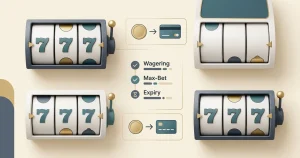
RTP describes a game’s designed return over total stakes, while payment methods and withdrawal timing affect access to funds.
How to Read RTP and House-Edge Figures
Return to player (RTP) and house edge are two ways of describing the same underlying maths. RTP states the share of money wagered that a game is designed to return over time. House edge describes the share retained by the casino. One figure looks at the player’s return; the other looks at the casino’s advantage.
The UK Gambling Commission allows gambling risks to be explained using either RTP or house-edge percentages. That choice of framing matters: a larger RTP figure can sound more appealing, while a smaller house-edge figure can make the same maths seem less costly. Neither label changes the game’s underlying calculation.
Reading an RTP percentage
An RTP of 90% means that, across the amount bet, £90 is returned for every £100 wagered. The remaining £10 is the house edge. It is useful to keep the wording precise: RTP describes the designed return in relation to total stakes, not a promise that you will receive a fixed share of your own deposits or end a session ahead.
When you compare online casinos, payout speed is one practical detail to check alongside the terms that matter to you. This list gives you the available payout-time information for each operator.
1. SlotoSport
Payout speed: 1-3 business days SlotoSport lists a payout speed of 1–3 business days, giving you a stated timeframe to consider.
2. Chanze
Payout speed: 1-3 business days Chanze lists a payout speed of 1–3 business days, so you have a stated timeframe to factor into your choice.
3. x3bet
Payout speed: 1-3 business days x3bet lists a payout speed of 1–3 business days, a useful detail for your payout-time comparison.
4. Zombillion
Payout speed: 1-3 business days Zombillion lists a payout speed of 1–3 business days, giving you a clear stated timeframe for payouts.
5. NightLuck
Payout speed: 1-3 business days NightLuck lists a payout speed of 1–3 business days, which you can take into account when reviewing payout details.
6. EvoSpin
Payout speed: 1-3 business days EvoSpin lists a payout speed of 1–3 business days, giving you one concrete payout detail to consider.
7. Dieselwin
Payout speed: 1-3 business days Dieselwin lists a payout speed of 1–3 business days, so you have a stated timeframe to consult.
8. SpinFormula
Payout speed: 1-3 business days SpinFormula lists a payout speed of 1–3 business days, a useful point for you to note when checking payout terms.
9. Revery Play
Payout speed: 1-3 business days Revery Play lists a payout speed of 1–3 business days, giving you a stated timeframe to consider.
10. NightWin
Payout speed: 1-3 business days NightWin lists a payout speed of 1–3 business days, which you can use as one part of your assessment.
The same percentage is not a forecast for an individual player. A published figure describes the game’s mathematical return, not the result of a particular set of spins. The actual sequence can vary, and a short session may bear little resemblance to the percentage printed in a game’s information. Treating RTP as a personal payout estimate is a category error.
That distinction is especially important when comparing slots. Their RTPs usually fall in a range from 92% to 98%, but a higher published figure does not tell you what will happen in your next session. It gives you a basis for comparing the stated maths of titles, not a way to predict which one will produce a win. A headline percentage is a comparison point, not a guarantee.
The same maths, two frames
RTP and house edge are complementary descriptions. If a game’s RTP is 90%, its house edge is 10%; if the house edge is expressed as 10%, the corresponding RTP is 90%. The two numbers add to the whole stake in this simplified presentation. They do not represent separate fees or competing measurements.
Consider how the wording changes the impression. “The game returns 90%” places the focus on what is returned. “The house edge is 10%” places it on the casino’s share. Both communicate the same relationship between stakes and expected return. If you are comparing games, translate one form into the other before deciding that one figure is more favourable. Otherwise, the framing can do more work than the maths.
Merkur Casino Online UK: Games and Site Checks
For a direct comparison, use the same measure for every title. Compare RTP with RTP, or convert house edge into its corresponding RTP before making a table. Mixing the two columns without labelling them can make a lower number appear better merely because it is presented as house edge rather than return. The arithmetic is straightforward; the labels are where confusion tends to enter.
What a higher figure can tell you
When you look for slots with the highest RTP in the UK, the useful question is not simply which percentage is largest. First check that the figure is the published RTP for the specific game you are considering. Then compare like with like: the stated return, the paytable, and the game’s volatility information should all be part of your reading.
A published RTP helps you compare titles on one defined criterion: their stated long-term return. If two slots differ on that criterion, the one with the higher published RTP has the more favourable return figure. That does not make it the better choice for every player or every purpose. Your preference may also depend on other game characteristics, and the percentage alone does not describe the experience of a session.
Volatility ratings provide a separate piece of information. They should not be confused with RTP: RTP is the return figure, while volatility is another characteristic to review when assessing a game. Read the paytable as well, so you can see how the game describes its features and prizes rather than relying on a large percentage in isolation. A neat comparison table is more useful than a headline winner with no stated criterion.
Do
- Compare RTP with RTP
- Convert house edge into RTP before making a table
- Use the same measure for every title
Don’t
- Mix RTP and house edge in the same column
- Treat RTP as a personal payout estimate
- Mistake a headline percentage for a guarantee
The same care applies when comparing casinos or searching for an online casino with a high RTP. RTP belongs to a game’s published information; it should not be treated as a blanket promise about every title available at a casino. If the comparison is about games, compare the games’ figures. If you are judging an operator, do not infer a site-wide return from a single slot’s percentage. The criterion needs to match the claim.
Why the figure does not predict a session
RTP is a mathematical description, not a schedule of returns. It does not say that a player will receive the stated proportion after a set of spins, nor that the game will distribute wins evenly. In the short term, outcomes can differ considerably from a game’s published RTP. Almost any outcome is possible over a short run, despite theories that a game is “due” to move towards its stated percentage.
That is why a high RTP should not be read as a higher chance of winning in the next session. It does not promise a win, specify when one might occur, or turn a loss into evidence that the game must soon pay back. The number remains useful for comparing the stated maths; it is simply not a short-term forecast.
When you check a slot, use a consistent sequence: find its published RTP, compare it with other titles, read the paytable, review volatility information, and look for testing or certification details. Each step answers a different question. The RTP gives a return comparison; the other details help you understand the game and the information provided about it. No single figure does all of that work.
Casino Guides for UK Deposits, Apps and Licensing · Non-GamStop European Casinos: How Exclusion Works · £1 Minimum Deposit Casinos in the UK: How They Work
For a practical comparison, record the game name and published RTP, then note the paytable and volatility separately. Keep the figures in their proper columns. This avoids treating volatility as a return percentage or mistaking a casino’s wording for a guarantee. The better comparison is the one that makes the criterion explicit, not the one with the most impressive-looking number.
If you are comparing slots, RTP can identify which published return is higher. It cannot identify a certain winner for tonight, and it cannot promise that you will personally receive the displayed percentage. Keep those two statements together: the figure is meaningful for comparison, and limited as a prediction. That is the whole point.
Casino RTP Is a Long-Run Measure, Not a Withdrawal Promise
“Highest paying” can describe two different things: the return built into gambling over time, or how quickly a casino sends an approved withdrawal. They are not interchangeable. A casino-level RTP is about the first. It does not tell you when money will reach your bank account.
RTP, or return to player, describes the share of wagers that a game or group of games is designed to return over a very large volume of play. If a casino’s overall RTP were 97%, the corresponding long-run calculation would be £97 returned for every £100 wagered across its players and games. That is an aggregate mathematical expectation, not a promise that an individual customer will receive that amount.
Attention: A casino-level RTP is an aggregate mathematical expectation and not a promise that an individual customer will receive that amount.
The distinction matters when comparing casinos. A headline figure is meaningful only if you know what it covers: a particular game, a selection of games, or the casino’s activity in aggregate. Those are different measures. A casino-wide figure cannot tell you what a particular game returns, and it cannot establish that your own account will finish ahead. The word “paying” sounds immediate. RTP is not.
What a casino-level figure can tell you
At casino level, RTP can offer a broad view of the theoretical returns associated with the games included in the calculation, over time and across many players. It is not the same as a cash-out rate, a promise about an individual session, or a measure of how quickly a withdrawal request is handled.
That means a comparison needs a clear criterion. If you are comparing long-run theoretical return, look for figures that refer to the same scope and can be understood on that basis. If you are comparing access to winnings, the relevant question is withdrawal processing, not RTP. A site may score well by one measure and differently by the other; calling either one “highest paying” without saying which criterion you mean obscures the comparison.
Nor does a casino’s regulatory status turn RTP into a guarantee. The UK Gambling Commission regulates gambling activity in the United Kingdom, including online casinos. In Great Britain, it is the sole regulator for commercial gambling and oversees remote gambling offered to consumers there, wherever the key equipment is located. It issues operating licences to businesses and personal licences to people working in the sector. These are regulatory functions, not a promise of a particular return or payout timetable.
A licence is therefore relevant when assessing whether an operator is authorised to serve the market, but it is not a ranking of casinos by RTP. Keep the measures separate: regulation concerns the operator’s permission and obligations; RTP concerns theoretical returns over time; withdrawal handling concerns the processing of requests.
Casinos Without a UK Licence: What It Means
When you see a casino described as one of the highest-paying options, ask what “paying” means in that comparison. Is it a stated long-run return, or a claim about how promptly withdrawals are processed? Without that distinction, a ranking can place unlike measures side by side and leave you with no reliable basis for choosing. The useful comparison is the one that names its criterion—and does not present a long-run calculation as money promised to you.
Payouts in Practice: Payment Options and Withdrawal Timing
A high-paying casino can mean two different things. You might mean a game’s long-run return, or you might mean how readily you can access money after requesting a withdrawal. Payment options and withdrawal handling address the second issue; they do not change a game’s published return. For practical comparisons, focus on the route your money can take in and out, and on how the operator handles a withdrawal request.
A specialist casino review has reported debit cards, PayPal, Apple Pay, Google Pay, open banking, bank transfers, Paysafecard, Skrill and Neteller among the payment options found at UK casinos. That is a snapshot of options reported by a review, not a promise that every casino supports every method now. Availability can differ between operators and can change, so check the payment information on the casino you are considering before you register or deposit.
Credit cards are not a permitted route for gambling deposits at UK-licensed casinos, including funds routed through money service businesses or certain e-wallets.
Compare the route, not just the logo
A familiar payment name does not tell you whether you can use it to deposit, withdraw, or both. Deposit and withdrawal availability are separate. A casino may list a method for adding funds without offering it for cashing out, or may set conditions on which withdrawal routes are available to your account. Treat the cashier’s current terms as the useful comparison, rather than assuming that a method works in both directions.
| Payment option | What to confirm before relying on it |
|---|---|
| Debit card | Whether it is accepted for deposits and whether withdrawals can be sent to it |
| PayPal | Whether the casino supports it for each transaction direction |
| Apple Pay or Google Pay | Whether the wallet is available for your intended transaction |
| Open banking or bank transfer | Which route the operator accepts and how it describes withdrawals |
| Paysafecard | Whether the casino permits withdrawals through this option |
| Skrill or Neteller | Whether the service is available for both deposits and withdrawals |
The table is a checklist, not a claim that each casino offers every route. In particular, do not infer withdrawal availability from a deposit button. Check the operator’s payment page and the cashier in your account, and read any stated conditions for the method you plan to use.
Credit cards are not a permitted route for gambling deposits at UK-licensed casinos. The restriction also covers credit-card funds routed through a money service business, and operators cannot accept wallet payments where the wallet allows credit-card funds to be used for gambling. An e-wallet is therefore not a workaround for a credit-card restriction. When checking a wallet, make sure the funding source and the operator’s rules both fit the permitted route.
What “fast withdrawal” actually describes
A specialist casino review has reported that withdrawal handling differs between UK casinos: some hold a request briefly, while the fastest sites act on requests almost immediately. This is a reported comparison, not a fixed timetable for every operator or every customer. It also describes the casino’s handling of the request, not a guarantee of when funds will appear in your account.
£10 Minimum Deposit Casinos in the UK: What to Know
That distinction matters when you compare claims about the highest-payout casino in the UK. A site that begins processing a request promptly may still not put money in your hands at the same moment. Before relying on a timing claim, check what the operator means by “processed”: does it refer to approving the request, releasing the funds, or their arrival through the selected payment route? If the wording is unclear, ask the operator before you deposit.
Look for the actual withdrawal policy rather than a broad label such as “instant”. Check whether the policy describes a review period, whether it says processing can vary, and whether different payment routes are treated differently. If a casino publishes separate information for different methods, compare the route you would use rather than choosing on a general site-wide claim. A published estimate is more useful when its starting point and end point are clear.
Comparing Payouts
Check the policy
Review the actual withdrawal policy to see if it describes a review period or if processing varies by payment route.
Define processed
Clarify if "processed" means the request was approved, funds were released, or funds arrived in your account.
Verify routes
Compare the specific payment route you intend to use rather than relying on a general site-wide claim.
There is no single payment method that makes a casino the best choice for everyone. You may value a familiar route, a particular withdrawal option, or a clearly stated handling process. The better fit is the casino whose current terms match the way you intend to deposit and withdraw—not simply the one with the most payment logos.
Verification can affect the first withdrawal
Remote operators serving consumers in Great Britain must establish a customer’s identity before gambling. That makes account verification part of the process, not an optional extra to think about only after a withdrawal request. Completing verification early can help avoid delays when you make a first withdrawal. Check what information the operator requests and whether your account shows any outstanding verification steps before you rely on a payout timetable.
This does not mean that verification is the only reason a request might take time, or that completing it guarantees immediate payment. It means you can avoid leaving a required account step until the point when you want to withdraw. Read the operator’s instructions and respond through its stated channel; do not assume that a withdrawal will proceed before the operator has completed the checks it requires.
For a fair comparison, separate three questions in your notes:
- Which methods does the casino currently accept for deposits?
- Which methods can it currently use for withdrawals?
- What does it say about the handling and arrival of a withdrawal?
Keeping those answers apart makes a promotional phrase such as “fast payouts” less persuasive on its own. A casino may have a broad choice of deposit routes but fewer withdrawal options, or describe processing speed without explaining the rest of the journey. The details matter more than the headline.
A practical comparison checklist
Before choosing where to play, open the payment and withdrawal information for each casino and record the method names exactly as the operator presents them. Mark deposit availability and withdrawal availability in separate columns. Then note any method-specific conditions, the operator’s explanation of processing, and any account checks that remain incomplete. If the information is missing or ambiguous, treat that as an unresolved point rather than filling it in with an assumption.
Use current operator information when making the comparison. Payment arrangements and withdrawal policies can change; a review is useful context, but it may not reflect the cashier you see today. Confirm the method and terms directly with the casino before depositing, especially if you need a particular route for a future withdrawal. A route that is convenient for adding money is not necessarily suitable for receiving it.
The UK Gambling Commission regulates remote gambling offered to consumers in Great Britain, including where an operator’s key equipment is located elsewhere. Remote operators serving those consumers must hold the relevant Commission licence. That regulatory framework does not mean that every operator has identical payment options or processes requests at the same speed. It is still necessary to compare the individual casino’s current terms.
When a casino’s withdrawal wording sounds unusually definite, read the conditions around it. Check whether the statement applies to every payment route and whether it describes processing or completed receipt. If you cannot establish what the claim covers, do not treat it as a dependable timetable. Clear terms are a better comparison criterion than a confident adjective.
Payout Comparison
- Record accepted deposit methods exactly as presented
- Mark available withdrawal methods in a separate column
- Note method-specific conditions
- Review the operator’s explanation of processing
- Confirm all account verification steps are complete
The practical answer to “which online casino pays out most?” depends on what you mean by pays out. If you mean a game’s return, payment handling is the wrong measure. If you mean access to funds, compare the withdrawal routes, the stated handling process and the account steps you must complete. Those criteria can point to different operators, depending on your needs.
A tidy comparison beats a slogan.
Which Casino Games Have the Highest RTP?
The broad comparison is clear: slots are published with RTPs usually ranging from 92% to 98%, while table games such as blackjack and roulette often exceed 99% when played with optimal strategy. That makes table games the stronger category by stated return under the right conditions. It does not make every table game, every version of a game or every way of playing it the better choice.
The deciding criterion is the figure attached to the particular game and the conditions behind it. A category-wide range helps you narrow the comparison, but it cannot tell you the RTP of a specific slot or table game. Check the game’s published information before comparing it with another title. A category label is a starting point, not a specification.
| Game category | Broad RTP picture | What to compare |
|---|---|---|
| Slots | Usually 92% to 98% | The published RTP for the specific title |
| Table games, including blackjack and roulette | Often above 99% with optimal strategy | The published return and whether you can use the relevant strategy |
The table is a broad comparison, not a ranking of individual games. The figures are not a promise about what you will receive, and they do not mean that every game in one category sits at the top of its range. To identify the better option by RTP, compare like with like: use the published return for each specific game rather than choosing on the basis of the category alone.
Why table games can lead on published return
The qualification “with optimal strategy” matters. For table games, the stated high return depends on how the game is played. If you do not know or follow the relevant strategy, you cannot assume that the higher category-level figure applies to your play. The game name by itself does not establish that you are comparing equivalent conditions.
That makes table games a stronger choice only under a defined criterion: published RTP when optimal strategy is used. If you are comparing the amount of strategic decision-making required, or simply prefer a different style of play, RTP alone does not settle the choice. A number can identify a mathematical advantage without deciding what you will enjoy or how well you can apply the strategy.
Blackjack and roulette are examples of table games that can exceed 99% RTP under optimal strategy. That does not mean every version has the same published return or that the figure is independent of play. Look at the information supplied for the particular game and read its rules before treating a broad comparison as relevant to you.
Table Games
Often exceed 99% RTP, but this usually requires the use of an optimal strategy.
Slots
Typically feature a published RTP ranging from 92% to 98%.
Game Information
Contains the specific published return, paytable, and volatility ratings for each title.
There is no useful shortcut in calling one game the casino game with the highest return without specifying the game and the conditions. The best-supported category comparison is that table games can have higher RTPs than slots when optimal strategy is used. An exact winner requires the published details for the games being compared. Without those, a precise ranking would be guesswork dressed as a table.
How to compare slots fairly
Slots usually have RTPs between 92% and 98%. That range is broad enough that comparing individual titles matters: one slot’s published return may differ from another’s, even though both belong to the same category. If RTP is your main criterion, use the value stated for each game rather than assuming that a familiar theme, provider or presentation signals a higher return.
A practical comparison starts with the game information, not the artwork. Find the published RTP for the title, then check the paytable so you understand how its features and payouts are described. If you are comparing more than one slot, record each title and its stated RTP side by side. That makes the criterion visible and prevents a vague impression of “high paying” from doing the work of a number.
Volatility ratings can also be reviewed when considering a slot, but they are a separate piece of information from RTP. Do not use one as a substitute for the other: a published RTP is the return figure to compare, while a volatility rating describes a different aspect of the game. If you want to assess a slot carefully, check both in the game information rather than collapsing them into a single idea of quality.
Pay by Phone Credit at UK Mobile Casinos
The same discipline applies to table games. Compare the published return, check the rules and consider whether optimal strategy is something you can apply. A headline figure above 99% is not a sufficient description on its own. The conditions attached to the figure are part of the comparison, not small print to ignore after choosing.
What “highest paying” can and cannot tell you
“Highest paying” is not a precise category unless you say what you mean by paying. In this comparison, RTP is the criterion: the published long-run return associated with a game. On that basis, table games such as blackjack and roulette can exceed 99% when played with optimal strategy, while slots usually sit in a 92% to 98% range. Those broad figures help compare categories, but they do not identify a particular casino or establish which individual game has the highest published RTP.
A casino’s overall presentation cannot replace the game-level comparison. If you are trying to find a casino with the highest RTP, first decide whether you mean the RTP of a specific game or a general claim about a casino. The figures relevant here describe game categories; they do not provide a verified operator ranking. A site offering a game does not, by that fact alone, show that it has the highest-return version of that game.
For a UK player, fairness is another check, but it answers a different question. Casinos licensed by the Gambling Commission must ensure that their games meet fairness standards. That requirement is not a claim that every game has the same RTP, nor does it tell you which game has the highest published return. Use fairness checks to assess whether games meet the required standards, and use each game’s published RTP to make the percentage comparison.
Game Selection
- Table games lead on broad RTP when optimal strategy is used
- Specific slots must be assessed by their own published information
- A high RTP is a long-run measure, not a short-term win guarantee
- Fairness standards do not mean all games have the same RTP
A sound comparison therefore has three parts: identify the game, read its published RTP and check the conditions that matter, including whether a table-game figure depends on optimal strategy. For slots, compare the individual titles rather than treating the category range as a rating for every game. For table games, do not detach a high figure from the strategy qualification. The winner depends on your criterion: table games lead on the broad RTP comparison when optimal strategy is used, while a specific slot can only be assessed by its own published information.
Before settling on a game, check its RTP, compare titles across providers, read the paytable, review any volatility rating and look for certification information. These checks make the basis of your choice clearer; they do not turn a category average into a personal result. That distinction keeps the comparison useful without claiming more than the published figures support. Short version: compare the game, not the label.
A High RTP Does Not Mean a Higher Chance of Winning Tonight
A high Return to Player figure can look like a promising sign, but it does not tell you whether you are more likely to win during a particular session. RTP describes a game’s expected return over extensive play, not a schedule of results for one person. Your session may finish well above or well below the published figure.
That distinction matters when comparing casino games by their apparent winning odds. “Winning” might mean receiving any payout, ending a round ahead, or finishing a session with more money than you started with. Those are different outcomes. A game’s RTP alone does not answer all of them, nor does it establish which game gives you the greatest chance of leaving in profit.
Trusted Casinos Not on GamStop UK: What to Check
The same caution applies to slots with a high potential payout. A large possible prize is not evidence that it is likely to appear in your session. Potential describes what a game can award; likelihood concerns how often a particular result occurs. Treating the two as interchangeable turns an attractive possibility into a misleading expectation.
Short sessions contain too little play to resemble a long-run return neatly. A result can be unusually favourable, unusually poor, or somewhere between those extremes. No pattern in the RTP figure makes a particular short-term result due, and a previous run does not ensure that the next one will balance it out. Randomness does not keep a timetable.
So, if you are asking which casino game offers the highest chance of winning, first decide what you mean by winning. Then look for information that directly addresses that outcome, rather than using RTP as a substitute. A published return can help compare games on their long-run maths; it cannot, by itself, tell you how likely you are to collect a payout or finish ahead tonight.
Non-UK Licensed Casinos: What the Licence Means
That is also why claims about “best odds” need a clear criterion. A title may return a greater share of wagers over time without making a win in your next session more likely. Another may produce frequent small returns while still leaving you down overall. The number of payout events and the total value returned are not the same measure.
You can check the game’s published information, but read it for what it measures. Do not turn a long-run percentage into a forecast for a single visit, or assume a higher figure means a better chance of a profitable result. Individual sessions can diverge substantially from the stated return, and almost any short-run result remains possible.
A useful comparison therefore separates two questions: how much a game is designed to return across prolonged play, and what result you might see in a brief session. The first can be assessed from RTP. The second cannot be settled by that figure alone.
Long-run maths. Short-run uncertainty.
What RTP rate should I look for at UK online casinos?
For slots, compare the published RTP of each specific game; slots commonly range from 92% to 98%. A higher figure is a more favourable stated return, but it does not predict what you will receive in a session.
Which casino games have the highest payout rates?
Table games such as blackjack and roulette often exceed 99% RTP when played with optimal strategy. Check the published figure and the rules for the specific game.
What is the best online casino in the UK for fast withdrawals?
Some UK casinos hold withdrawals briefly, while the fastest process requests almost immediately. Check the casino’s withdrawal processing information before choosing where to play.
How do I check if an online casino is licensed in the UK?
Search the UK Gambling Commission’s public register for the operator and check that its relevant remote casino licence is active and current.
What are the UK online casino licensing requirements?
Remote operators serving consumers in Great Britain need the relevant Gambling Commission licence, regardless of where their key equipment is located. They must establish a customer’s identity before gambling and prompt new remote customers to consider a financial limit before their first deposit.
What are the differences between UK-licensed and non-UK-regulated online casinos?
Operators offering remote gambling to consumers in Great Britain require the relevant UK Gambling Commission licence, regardless of where their key equipment is located. A licence from another regulator does not replace that requirement.
Material created by the team Betmac Casino