The guide explains how overseas licensing differs from UKGC regulation and what that may mean for player protections and account risks.
What “Without a UK Licence” Means
A non-UK-regulated casino is an online gambling site that operates without oversight from the UK Gambling Commission (UKGC). The phrase “without a UK licence” refers to the operator’s regulatory status in the British market; it does not necessarily mean the site has no licence at all. Some such casinos hold authorisation from another jurisdiction, while others may not have a licence that applies to the service they offer.
That distinction matters. A licence issued overseas is not a substitute for a UKGC licence. The regulator named on a casino’s website may tell you where the operator is authorised, but it does not establish that the operator is authorised to serve customers in Great Britain.
| What you are checking | What it tells you |
|---|---|
| UKGC authorisation | Whether the operator holds the licence required to serve customers in Great Britain |
| An overseas licence | Whether the operator is licensed by another jurisdiction, subject to that licence’s scope |
| The operator’s location | Where the business is based; this does not decide whether it needs UKGC authorisation |
When considering a casino without a Swedish licence in 2026, check the available details carefully and decide what matters to you. The listed payout speed is one practical point to keep in view.
1. SlotoSport
Payout speed: 1-3 business days SlotoSport lists a payout speed of 1–3 business days. You can use this as one detail to consider.
2. Chanze
Payout speed: 1-3 business days Chanze lists a payout speed of 1–3 business days. Keep this timing in mind when assessing whether it suits you.
3. x3bet
Payout speed: 1-3 business days x3bet lists a payout speed of 1–3 business days. This is the available payout information to consider.
4. Zombillion
Payout speed: 1-3 business days Zombillion lists a payout speed of 1–3 business days. You can factor this into your decision.
5. NightLuck
Payout speed: 1-3 business days NightLuck lists a payout speed of 1–3 business days. This gives you a stated timeframe to consider.
6. EvoSpin
Payout speed: 1-3 business days EvoSpin lists a payout speed of 1–3 business days. Consider this listed timing as part of your choice.
7. Dieselwin
Payout speed: 1-3 business days Dieselwin lists a payout speed of 1–3 business days. You can take this stated timeframe into account.
8. SpinFormula
Payout speed: 1-3 business days SpinFormula lists a payout speed of 1–3 business days. This is the available detail about its payouts.
9. Revery Play
Payout speed: 1-3 business days Revery Play lists a payout speed of 1–3 business days. Keep this stated timing in mind as you assess it.
10. NightWin
Payout speed: 1-3 business days NightWin lists a payout speed of 1–3 business days. You can consider this timeframe when making your choice.
An overseas licence and a UKGC licence are different
Non-UK-regulated casinos are often licensed by jurisdictions such as Malta, Curaçao, Gibraltar or Anjouan. These are examples of overseas licensing locations, not alternative names for the UKGC. Each licence belongs to its own regulatory framework. Seeing a regulator’s name or badge on a site therefore answers a narrower question than whether the casino has UK authorisation.
For customers in Great Britain, the key test is the market being served, not the operator’s headquarters. Operators serving that market need a UKGC licence regardless of where they are based. A casino cannot turn an overseas licence into UKGC authorisation simply by displaying it prominently or accepting British customers.
This is the central difference behind searches for an online casino without a UK licence: the site may have an overseas licence, but it is still outside UKGC oversight. “Licensed” and “licensed for this market” are not interchangeable descriptions.
How to read the label
When a casino describes itself as international, foreign or offshore, those words do not identify its regulatory status. They may describe where the company operates from or how it presents its service. To understand what “without a UK licence” means for a particular site, separate three details: the operator’s claimed licence, the regulator that issued it, and whether the operator holds UKGC authorisation.
A claim of overseas licensing should not be treated as proof of UK permission. Nor does the absence of a UKGC licence prove, by itself, that the operator has no authorisation anywhere. These are separate checks, and the wording on a homepage can blur them.
Casino Guides for UK Deposits, Apps and Licensing
The practical comparison is straightforward: an online casino with UKGC authorisation is regulated by the UKGC for the British market; a non-UK-regulated casino operates without that oversight. An overseas licence may describe the site’s status elsewhere, but it does not change the second category into the first.
Why the wording can be confusing
“Casino without a UK licence” can sound as though the only question is whether a licence exists. The more precise question is which authority issued it and whether it covers the service being offered to the customer. A Malta-licensed casino and a UKGC-licensed casino do not hold the same authorisation merely because both use the word “licensed”.
Likewise, a site may be based outside Britain and still need UKGC authorisation if it serves customers in Great Britain. Location is not an exemption. The rule follows the market served, not the operator’s address.
When checking a site, look for a clear statement about UKGC authorisation rather than relying on a general “licensed casino” claim. If the site names only an overseas jurisdiction, that tells you it is presenting an overseas licence; it does not establish UKGC oversight. If the information is vague, treat the ambiguity as a reason to pause rather than as confirmation.
The useful distinction
For comparison, use two separate columns: “UKGC-licensed” and “licensed elsewhere”. The first identifies authorisation for the British market. The second identifies an overseas regulatory claim, whose relevance depends on that jurisdiction’s own rules. Combining both into a single “licensed” label hides the distinction that matters.
An overseas licence is not a substitute for UKGC authorisation and does not establish that an operator is authorised to serve customers in Great Britain.
A non-UK-licensed casino is therefore not simply a UK casino with a different office address. It is a site outside UKGC regulation, even if it holds a licence issued in another country. The licence’s existence and the operator’s UKGC status are different facts.
That is the baseline for understanding the term. An overseas licence may explain how a casino is regulated in another jurisdiction; only UKGC authorisation establishes that the operator holds the licence required to serve customers in Great Britain. The label alone is not enough.
Non-GamStop Casinos and the Limits of Self-Exclusion
GamStop is the UK Gambling Commission’s self-exclusion scheme. Casinos outside it are not connected to that scheme, so a GamStop exclusion does not create a block across every gambling website you might encounter. That distinction matters if you have excluded yourself because you want gambling access restricted, rather than merely reduced.
A non-GamStop casino may still accept registrations from people in the UK, but that does not make it part of GamStop or give your exclusion the same reach there. The name describes a gap in scheme coverage, not an alternative form of self-exclusion. If you are relying on GamStop to prevent you from gambling, treating a casino not on GamStop as a workaround would defeat the protection you chose.
What the gap means in practice
Self-exclusion is useful only within the services and operators covered by the arrangement. When a site is outside GamStop, the scheme cannot apply your exclusion to it. You may therefore be able to reach a site that is not included, even while your GamStop exclusion remains active elsewhere. The crucial point is that the exclusion has not been cancelled; the other site is simply outside its coverage.
Online casino sister sites in the UK: how to tell
That can make the boundary easy to misunderstand. Seeing an account available on a website does not mean your self-exclusion has failed across the UK system, nor does it mean the website will apply the same controls. It means you are dealing with a separate operator and a different set of protections. For someone trying to stop gambling, that separation can turn a barrier into a decision they must keep making for themselves.
If you enrolled in GamStop to put distance between yourself and gambling, searching for UK casino sites not on GamStop can undermine that plan. A site’s accessibility is not evidence that it is suitable for someone who has chosen self-exclusion. The more relevant comparison is not which site offers the easiest route to an account, but whether it respects the boundary you wanted to establish. It may not.
Controls are not interchangeable
UKGC-licensed operators must provide mandatory responsible-gambling tools. At a non-UK-regulated casino, you do not retain access to those UK-mandated protections in the same way. The operator may offer its own controls, but you should not assume that they match the requirements or coverage of tools available through a UKGC-regulated service.
Rules around responsible gambling and data protection may also be less stringent outside UKGC regulation. That does not mean every individual site behaves identically; it means you cannot rely on the UK framework to set the same baseline for the operator. A button or setting labelled as a limit or exclusion should not be treated as equivalent to a national scheme simply because the wording sounds familiar.
Self-Exclusion Risk
Using a non-GamStop casino as a workaround can undermine your protection and defeat the purpose of the self-exclusion you chose.
This is why “best” is a poor measure for someone relying on self-exclusion. A site might appear attractive on access or account features, while the criterion that matters most to you is whether it can keep you away from gambling. If it is outside GamStop, it cannot extend your GamStop exclusion to itself. For that need, a more appealing offer or smoother registration does not compensate for the missing connection. The distinction is practical, not cosmetic.
Consider the support you lose
Playing at an offshore casino also means giving up access to the UK’s Financial Ombudsman Service and the mandatory responsible-gambling tools associated with UKGC-regulated operators. Those protections are not transferred to a non-GamStop site. If you are accustomed to relying on UK systems, do not assume that the same routes or safeguards will be available when dealing with an operator outside them.
Before taking any action, be honest about why you self-excluded. If it was to prevent further gambling, an offshore casino not on GamStop does not solve the problem that led you to register. It may offer access precisely where you intended to create a boundary. That is a material risk, not a minor difference in website policy.
A practical response is to avoid opening an account or depositing while your aim is to remain excluded. If you are already gambling and find it difficult to stop, focus on support rather than looking for another site. The scheme’s limits do not make your original decision less valid; they show why relying on one exclusion measure alone may leave gaps outside its reach.
Gibraltar Casino Licence and UK Gambling Rules
The comparison is straightforward: GamStop covers participating services, while a casino outside the scheme is not subject to your GamStop exclusion. UK-mandated tools and complaint protections do not follow you there. If self-exclusion is part of your plan to control gambling, access to a non-GamStop casino is not extra flexibility. It is a route around the boundary.
Anjouan Licences: What They Cover—and What They Do Not
An Anjouan casino licence should be read as a limited regulatory credential, not as permission to serve customers everywhere. It does not authorise a casino to operate in the United Kingdom or in other markets listed as restricted. A site may display the licence while still lacking permission to offer gambling in the country where you live.
That distinction matters if you are comparing casinos without a UKGC licence. A licence issued by Anjouan does not become a UK Gambling Commission licence simply because the casino accepts a visit from a British customer, advertises games in pounds or makes its website available in the UK. The regulator and the markets covered are different. The licence cannot be treated as a substitute for UK authorisation.
What to check on the licence
Before relying on a licence claim, compare the operator’s details with the public licence register. Check that the entry is current, that its expiry date has not passed, and that the company named on the casino site matches the company associated with the licence. A badge in a footer is not the same thing as a verified match. If the names differ or the entry cannot be confirmed, the badge alone does not resolve the question.
Verifying a Licence
Check the register
Compare the operator’s details with the public licence register to ensure the entry is current.
Verify dates
Confirm that the licence expiry date has not passed.
Match the company
Ensure the company named on the casino site matches the company associated with the licence.
This is a basic identity check, not a guarantee about how the casino will handle every aspect of its service. A valid Anjouan casino licence does not, by itself, establish that a particular game has been independently tested, that player balances are protected if the company fails, or that you can take a complaint to an independent adjudicator. Those are separate questions, and the framework does not require the safeguards that would answer them.
The difference is easy to miss because licence logos often sit beside familiar game titles and polished account pages. Presentation is not regulatory coverage. The relevant test is not whether the site looks established, but what the licence permits and which protections it requires.
Testing, audits and player funds
Anjouan’s framework does not mandate RNG testing or audits. It also does not require operators to keep player funds segregated from business funds. These omissions matter in different ways. Without mandated RNG testing, the framework does not itself require the testing assurance associated with independently checked game randomness. Without required audits, it does not set that safeguard as a condition of the licence. Neither point, on its own, proves that a casino’s games are unfair; it means the licence does not require those checks.
The position on balances is more direct. An Anjouan-licensed casino does not have to segregate player money, so the licence does not guarantee that funds held for customers are kept apart from the operator’s own money. If the operator fails, players are unsecured creditors. In practical terms, a balance shown in your account is not the same as a protected deposit held separately for you.
Curacao Casino Licence in the UK: What It Means
This is a material difference for anyone weighing a new casino without a UK licence against a UKGC-regulated option. A licence may show that an operator has a relationship with a regulator, but the safeguards attached to that relationship determine what the licence does for you. Here, the framework does not make fund segregation, audits or RNG testing mandatory. A reassuring logo cannot fill those gaps.
Self-exclusion and independent complaints
An Anjouan-licensed casino is not required to integrate GAMSTOP. If you use that scheme to exclude yourself from gambling, do not assume the exclusion will prevent access to a casino operating under this licence. The site is outside the scheme’s required coverage.
The same limit applies to complaints. Anjouan-licensed casinos are not required to offer an independent alternative dispute resolution process comparable to services approved by the UK Gambling Commission. A casino may have its own complaints procedure, but that is not equivalent to independent adjudication. The Anjouan authority does not handle, mediate or decide player complaints, either. Its role should not be mistaken for a route to recover funds or overturn an operator’s decision.
That distinction is particularly important when comparing offers or deciding whether a casino is “best”. The answer depends on your criterion: a prominent licence claim may matter less to you than independent complaint handling or protection for money on account. Under this framework, those safeguards are not guaranteed. The credential has limits.
Anjouan Licence Limits
- No authorisation to operate in the UK or restricted markets
- No required integration with GAMSTOP
- No mandated RNG testing or audits
- No requirement to segregate player funds
- No independent ADR for dispute resolution
An Anjouan casino licence therefore tells you neither that the casino is authorised in the UK nor that it provides the protections associated with UKGC oversight. Confirm the licence entry and company identity, then assess the limits plainly: restricted-market conditions, no required GAMSTOP integration, no comparable independent ADR, and no mandated testing, audits or segregation of player funds. These are not minor details hidden in fine print; they define what the licence does not promise.
What UK Law Says About Players Using Overseas Casinos
UK gambling law draws an important distinction between the business offering a service and the person who uses it. The Gambling Act 2005 places its main licensing obligations on operators supplying gambling to customers in Great Britain. A company cannot avoid those requirements simply by running its website from another country: operators serving the British market need authorisation from the UK Gambling Commission.
That is the operator’s position. It does not mean that a British player who uses a site without UKGC authorisation commits a criminal offence. UK law does not expressly make it a crime for an individual to use gambling services licensed elsewhere, and playing on an unlicensed site is not itself a criminal offence for the player.
Malta MGA Licence and UK Online Casinos: Key Checks
Those points can sound contradictory until the two roles are separated. The operator may be supplying services into a market where it lacks the required permission; the player is not subject to that same operator-licensing duty. So a non-UKGC casino can be outside the rules that apply to businesses serving Great Britain without the act of playing there becoming a criminal offence for you.
This is a narrow statement about criminal liability, not a declaration that every overseas site is lawful or suitable for British customers. Online gambling in Great Britain is regulated through UKGC licensing, and a licence issued by another country does not replace that requirement for an operator serving the British market. “Licensed abroad” and “authorised to serve Great Britain” are different claims.
The geographic detail matters, too. The Gambling Act 2005 applies in England, Wales and Scotland, but not Northern Ireland. If you live in Northern Ireland, do not assume that the position is identical: check the rules relevant to your location before using a gambling service. More generally, you remain responsible for checking local law and understanding the implications of using a site based outside the UK.
Operator rules are not player permission
When assessing a casino not licensed by the UKGC, keep three questions separate:
- Does the operator hold a UKGC licence to serve customers in Great Britain?
- What does the law in your own location say about using the service?
- What practical consequences could follow if you choose to use it?
The first question concerns the operator’s authority. The second concerns your local legal position; the third is a personal decision about risk. A foreign licence may show that a company is regulated somewhere, but it does not establish that the company is authorised to offer gambling to people in Great Britain.
Nor does the absence of a criminal offence for a player amount to UK regulatory approval. It should not be read as a recommendation to use the site, or as a guarantee that its terms, service or handling of a dispute will meet UK standards. The legal distinction is straightforward; the consequences of choosing a non-UKGC casino are a separate matter.
In short, UK rules place the licensing obligation on operators targeting the British market, while players are not criminally liable merely for gambling on an unlicensed site. Keep those two points distinct, then check the law that applies where you live before deciding what to do.
Legal Distinction
While operators serving the British market must have UKGC authorisation, UK law does not expressly make it a criminal offence for an individual player to use gambling services licensed elsewhere.
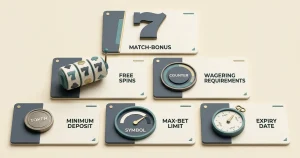
Bonus Terms: Check the Wagering Before the Headline Offer
A welcome bonus at a casino not on GamStop is not worth judging by its advertised size alone. The key comparison is how much wagering the terms require, what balance the requirement applies to, and whether a withdrawal cap or expiry changes what you can keep. A no-deposit offer is not automatically the better deal: the same conditions can make winnings difficult to withdraw.
Wagering requirements set the amount you must stake before bonus-related winnings become withdrawable. Read the multiplier alongside its base. A specialist review reports offshore welcome offers with requirements of 35x or more, but the multiplier alone does not tell you the total turnover: the terms may apply it to the bonus, the deposit and bonus together, or another stated amount.
A separate specialist review describes offers with a 40x requirement applied in different ways, including to the bonus alone or to the bonus and deposit combined; some terms may also group free spins with the bonus. Those bases produce different obligations. Before accepting, identify exactly which funds or winnings count, which games contribute, and whether the offer has to be activated. If the terms do not make the calculation clear, the headline figure is not enough to compare it fairly.
Free spins have their own conditions
Free spins can look simpler because they do not require a deposit to use, but winnings may still carry wagering requirements. Specialist reviews report examples where free-spin winnings are subject to wagering of 30–50 times the winnings, alongside withdrawal caps of £5–£50. These are reported offer conditions, not a rule that applies to every casino or promotion. Check whether the cap limits the amount you can withdraw from the spins, and whether the wagering applies before that cap.
Expiry matters too. Specialist reviews report free-spin packages with expiry periods of 24–72 hours. Check when the clock starts and whether unused spins or winnings disappear when the offer expires. A short window can make an offer less useful if you cannot meet its conditions in time.
For any promotion—including a no-deposit bonus at a casino not on GamStop—compare the same criteria: wagering base, eligible games, maximum withdrawal and expiry. With a pay-and-play casino not on GamStop, the payment label does not answer any of those bonus questions. The offer terms do. A large headline amount can rank lower than a smaller one if its wagering base is broader or its cap tighter. Read the complete terms before opting in; an advertised bonus is not cash you can assume is immediately withdrawable.
How Offshore Payment Options Can Differ
A non-UK-regulated casino may offer several ways to fund an account, but the payment menu is not a promise that every route will suit you. Options can include credit cards, e-wallets, bank transfers and cryptocurrencies. Some sites handle transactions through alternative payment processors, so the method shown at checkout may not be the same as a familiar direct bank or card payment.
Do
- Check if the method is available at the point of deposit
- Verify the route for withdrawals
- Review payment terms before transferring funds
Don’t
- Assume deposit methods are available for withdrawals
- Rely on the deposit screen as a complete guide
- Treat different payment logos as interchangeable
Compare the options by what matters to you: whether you can use the method, what information it requires, and whether the casino says it supports that route for both deposits and withdrawals. A payment option being available for a deposit does not mean you can later receive money through it. The casino may use separate routes for incoming and outgoing payments, and its cashier terms should spell out the distinction. Check before paying, rather than treating the deposit screen as a complete guide.
Crypto is one possible route at some sites. Because cryptocurrency is not a credit card, using it can avoid the UK restriction on gambling funded by credit cards. That does not make the casino UK-regulated, nor does it make crypto equivalent to a card payment: it is a different payment type, with its own practical considerations. If you are comparing methods, the useful criterion is not simply whether a casino accepts crypto, but whether you understand the route and its terms before transferring funds.
A specialist review has also reported that some operators may let customers fund accounts through a mobile phone charge or a prepaid balance. Treat that as a possibility to verify with the operator, not as a standard feature across non-UK casinos. Availability can depend on the particular site and the payment arrangements it uses.
A short checklist helps separate a broad-looking cashier from a usable one:
- Is the method available to you at the point of deposit?
- Does the cashier identify a different route for withdrawals?
- Are the payment terms clear before you transfer funds?
If an option is not explained, ask the operator for clarification before using it. The practical winner depends on your priority: a familiar transfer, an e-wallet, a card, or a digital currency are not interchangeable simply because they appear in the same menu. Check the route, not just the logo.
New Offshore Casinos: Verification and Account Risks
A new non-UK casino may look straightforward when you open an account, but the difficult part can come later: a request for documents or a withdrawal that remains pending. Treat verification as an account-use risk, not a box to tick once and forget.
Identity checks may be requested when you try to withdraw. A specialist review has reported cases in which an offshore operator asked for notarised documents or a video call at that stage. That is a reported possibility, not a standard requirement across all sites. If a request seems unusually onerous, pause before sending sensitive material. Check that it matches the operator’s published terms and use only a contact route you can verify as belonging to the operator.
Keep a record of what you submit, when you submit it and any replies. If the operator asks for the same information repeatedly, changes its requirements, or does not explain why a document is needed, retain the messages and ask for a clear account of what remains outstanding. A new brand’s polished interface does not tell you how it will handle an account review.
Avoid depositing more than you can afford to leave inaccessible while an account is being reviewed, as some withdrawals may take several weeks.
Withdrawal timing reports also conflict. Some describe payments arriving within 24 hours to 5 business days; others say a wait can stretch to three or four weeks. For non-UK-regulated casinos, there is no regulatory clock to enforce a particular payout timetable. A pending withdrawal may therefore leave you with little leverage to speed up the process. Check the operator’s stated verification and withdrawal terms before depositing, and avoid treating an advertised processing estimate as a guaranteed date.
A practical comparison is simple: how clear are the document rules, how are requests communicated, and what does the operator say happens if verification is incomplete? If those points are difficult to establish before you open an account, the uncertainty itself is relevant. Do not deposit more than you can afford to leave inaccessible while an account is reviewed.
Keep copies of the terms in force when you register, along with withdrawal confirmations and support conversations. If a request or delay occurs, a dated record gives you a clearer basis for asking the operator to explain its decision. It does not guarantee a particular outcome. Verification can become a gate, not a formality.
What UK Players Give Up Outside UKGC Regulation
A non-UK-regulated casino may offer a different mix of games or features, but the comparison should include what happens when you need protection. For UK players, the key difference is not whether a site looks polished. It is whether its safeguards and complaint routes are backed by the UK Gambling Commission.
UKGC-licensed operators must provide responsible-gambling tools within the British regulatory framework. At a non-UK-regulated casino, those protections may be less stringent, and you do not have access to the same mandatory tools. That can mean fewer dependable ways to manage gambling activity through the operator. Do not assume that a feature shown on a site is equivalent to a UK requirement: its availability, operation and oversight may differ.
The gap matters most if you are choosing a site because it appears to offer more flexibility. A newer casino or one described as among the best for UK players is not necessarily better on player protection. Compare the safeguards by a specific criterion: whether they are required by UK regulation and whether you can rely on them being available. A broad claim about responsible gambling tells you less than a clear explanation of the tools and the rules governing them.
There is also a difference in where you can take a complaint. If you gamble at a non-UK-regulated casino, you forfeit access to the UK’s Financial Ombudsman Service in relation to that gambling relationship, as well as the mandatory responsible-gambling tools provided under the UK framework. You should not expect the UK Gambling Commission to resolve a dispute with an operator that it does not regulate. If terms change or a problem arises, the routes available to you may not provide the same protection as UK-regulated channels.
Data protection is another point to weigh. Non-UK-regulated casinos may operate under less stringent data-protection rules than UKGC-licensed operators. That does not establish how a particular site handles your information, but it does mean that UK regulatory standards should not be assumed to apply. Read the operator’s privacy information and consider what personal data you are prepared to provide.
Risks of Non-Regulation
- Loss of access to the UK Financial Ombudsman Service
- Absence of mandatory UKGC responsible-gambling tools
- Potentially less stringent data protection rules
- No UKGC oversight for dispute resolution
The better choice depends on your priority, but a more attractive offer or newer interface does not replace regulatory safeguards. Before using any non-UK-regulated casino, you are responsible for checking the law that applies to you and understanding the implications. Flexibility has a cost.
Overseas Casino Withdrawals: Timing and Limits
A withdrawal request is not the same as money arriving in your account. At non-UK-regulated casinos, reported timings vary: some accounts describe withdrawals arriving within 24 hours to 5 business days, while other information gives a possible wait of three or four weeks. Those accounts disagree, so the shorter window should not be treated as a promise. Processing can depend on the payment method, and a casino’s own checks may also affect when a request is completed.
There is no regulatory clock to enforce a stated processing time at a non-UK-regulated casino. Before requesting a payout, read the withdrawal terms and distinguish between the operator’s processing stage and the time the payment takes to reach you. A displayed estimate is useful only if the terms explain what it covers. Keep a record of the request and any status updates, so you can compare the actual progress with the casino’s stated process.
The other important criterion is the withdrawal limit. A specialist review has reported that some casinos set daily, weekly or monthly caps. Because this is not a fixed feature across all operators, check the specific terms rather than assuming a limit applies—or that there is none. If a cap is lower than your balance, a larger win may have to be paid in instalments instead of one transfer. That can extend the time before you receive the full amount, even if each individual payment is processed promptly.
Check whether limits apply to the amount requested, the amount paid out, or a particular period. Also look for rules that could affect pending withdrawals if you make another request. The practical comparison is not simply “fast” versus “slow”: it is the stated processing time, the applicable cap and how many instalments those terms could require. Read the payout conditions before you rely on a casino’s headline timing.
Online casino no registration in the UK: checks
Disputes at Casinos Outside UKGC Regulation
If a disagreement arises at an Anjouan-licensed casino, the first complaint route is generally the operator itself. Set out the issue clearly, identify the relevant account activity or term, and keep copies of messages and any supporting records. Use the contact channel named in the casino’s terms and conditions, and retain proof of when you submitted the complaint.
Under Anjouan’s framework, the operator must respond within 30 calendar days. That requirement is about receiving a response; it does not guarantee that the casino will agree with you or provide the outcome you seek. A written reply is more useful than an informal exchange because it makes the operator’s position and reasons easier to track.
The next step is less reassuring. Anjouan’s authority does not handle, mediate or decide complaints from individual players. An Anjouan casino also does not provide an independent dispute-resolution route comparable to the alternative dispute resolution services approved for UKGC-regulated operators. So, if the operator rejects your complaint, there may be no independent body under that framework for you to ask to review the decision.
That distinction matters: a licensing authority’s role is not automatically to settle every customer dispute. Do not assume that contacting Anjouan will produce an investigation or a ruling on your case. The route available to you may depend on the operator’s own complaints process and the terms attached to your account.
Before depositing, check whether the site explains how to complain, where to send a complaint and what happens if you remain dissatisfied. Save the version of the terms you accepted, along with relevant account records. If you are already in a dispute, keep your messages factual and ask the operator to address each point in writing.
For a casino outside UKGC regulation, the central difference is the lack of an equivalent independent route. A response deadline is not the same as independent review.
Are Anjouan casinos connected to the GamStop self-exclusion scheme?
No. Anjouan casinos are not required to integrate with GamStop, so a GamStop exclusion does not block access to them.
What happens if I have a dispute with an Anjouan-licensed casino as a UK player?
You do not have access to an independent dispute resolution route comparable to UKGC-approved services, and the Anjouan authority does not handle or decide player complaints. The operator must respond to your complaint within 30 calendar days.
What is the biggest risk of playing at a non-UK-regulated casino?
You lack key protections available through UKGC-regulated services, including access to the UK’s Financial Ombudsman Service and mandatory responsible-gambling tools. With an Anjouan-licensed casino, player funds are not guaranteed to be segregated, so you may be an unsecured creditor if the operator fails.
Are non-UK regulated casinos legal for UK players to use?
UK law does not explicitly prohibit British citizens from using gambling services licensed in other countries, and players do not commit a criminal offence by gambling on an unlicensed site. However, operators serving customers in Great Britain need a UK Gambling Commission licence.
Are sites that are not on GamStop legal for players in the UK to access?
UK law does not explicitly prohibit British citizens from using gambling services licensed in other countries, and players do not commit a criminal offence by using an unlicensed site. Operators serving customers in Great Britain still need a UK Gambling Commission licence.
Are gaming sites not on GamStop permitted for UK players?
UK law does not explicitly prohibit British citizens from using gambling services licensed in other countries, and players do not commit a criminal offence by using an unlicensed site. But a site serving customers in Great Britain needs a UK Gambling Commission licence.
Material created by the team Betmac Casino