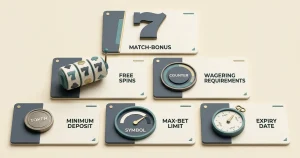


The casino adaptation shares the briefcase premise, but its rules, offers and features depend on the game’s own design.
From the TV Briefcases to the UK Casino Version
The television format is built around a simple comparison: is the money still hidden in a contestant’s briefcase worth more than the Banker’s offer? A contestant begins with one case and watches the others opened. In the opening round, three of the sixteen briefcases are revealed before the Banker makes an offer and the host asks whether to deal or continue. Later offers create further decision points. The show’s central tension is not a complicated puzzle; it is deciding whether to take a known offer or keep faith with an unknown amount.
The final choice on television gives the premise its familiar shape. Contestants are ultimately judging the value of the last unopened case against the Banker’s offer. That makes the format easy to recognise, but it does not make a casino adaptation identical to the programme. A televised contest has a live host, a contestant and a particular sequence of events. A casino game is a gambling product, and its rules and presentation are determined by that game’s own design. The shared title and briefcase theme are not, by themselves, proof that every detail of the broadcast format carries over.
If you’re weighing deal-or-no-deal casino options in the UK, payout speed is one practical detail to keep in view. Use this list to see which operators have a stated withdrawal timeframe.
1. SlotoSport
Payout speed: 1-3 business days SlotoSport lists a payout speed of 1–3 business days, giving you a stated timeframe to consider.
2. Chanze
Payout speed: 1-3 business days Chanze lists a payout speed of 1–3 business days. You can use that timeframe as one point of reference.
3. x3bet
Payout speed: 1-3 business days x3bet’s stated payout speed is 1–3 business days, a useful detail for you to note.
4. Zombillion
Payout speed: 1-3 business days Zombillion lists payouts as taking 1–3 business days. That gives you a stated timeframe to consider.
5. NightLuck
Payout speed: 1-3 business days NightLuck has a listed payout speed of 1–3 business days, which may help you assess the practical timing.
6. EvoSpin
Payout speed: 1-3 business days EvoSpin lists a payout speed of 1–3 business days. You have a stated timeframe to refer to.
7. Dieselwin
Payout speed: 1-3 business days Dieselwin’s listed payout speed is 1–3 business days, providing you with a clear timing detail.
8. SpinFormula
Payout speed: 1-3 business days SpinFormula lists payouts at 1–3 business days. You can take this stated timeframe into account.
9. Revery Play
Payout speed: 1-3 business days Revery Play has a listed payout speed of 1–3 business days, a practical detail for you to note.
10. NightWin
Payout speed: 1-3 business days NightWin lists a payout speed of 1–3 business days. This gives you a stated timeframe to consider.
That distinction matters when you are comparing Deal or No Deal casino games with the show. The television question is part of a staged contest: the contestant responds to an offer while the audience follows the cases being opened. A casino version should instead be understood through the rules presented for that game. The familiar Banker and briefcase imagery can signal the inspiration, but it does not tell you how a particular product works, what choices it gives you or how its result is determined. The name is a starting point, not a rulebook.
There is also a difference in what the word “game” means in these settings. On television, the format is entertainment built around a contestant’s decisions and the reveal of hidden amounts. In a casino, the product is offered as gambling. You should therefore assess it as a casino game rather than assuming that watching the programme explains how to play it. If you are deciding whether a Deal or No Deal slot or another casino version suits you, the useful comparison is the game’s stated rules and features—not how closely its theme resembles a television episode.
The UK regulatory setting adds a separate question: where and under what authority is the gambling product being offered? In Great Britain, the Gambling Commission is the regulator for commercial gambling. Its remit includes remote gambling offered to consumers there, even when the operator’s key equipment is located elsewhere. In other words, the location of a company’s servers does not remove the licensing requirement for an operator selling remote gambling into the British market.
Fastest Payout Online Casinos in the UK: What’s Known
The Commission issues operating licences to gambling businesses and personal licences to individuals working in specified roles. These are different forms of authorisation: the operating licence concerns the business providing gambling, while a personal licence applies to relevant people. For a player, the practical distinction is that a casino game’s familiar branding does not establish that the site offering it is authorised. A legal online casino serving British customers must hold the relevant Gambling Commission operating licence.
The Gambling Act 2005 provides the main statutory framework for gambling in England, Wales and Scotland. Northern Ireland is outside that Act’s scope, so it is better not to treat the UK’s legal arrangements as a single, identical system in every part of the country. For online casino play in Great Britain, however, the key point is clear: remote operators serving local customers must be licensed by the Gambling Commission, regardless of where their equipment is based. The Commission is the sole regulator for commercial gambling in Great Britain.
This makes regulation separate from the game’s theme and format. A title may look like the television show, but its resemblance does not establish who operates it or whether that operator is licensed. Likewise, a licensed site does not make every casino game a faithful reproduction of the broadcast rules. One question concerns the product; the other concerns the operator’s authority to offer gambling.
Licensing Check
A legal online casino serving British customers must hold the relevant Gambling Commission operating licence regardless of where its servers are located.
For a UK reader considering Deal or No Deal casino play in 2026, keep those checks in order: identify the casino game by its own rules, then consider whether the site is authorised to serve players in the relevant part of the country. The show explains the appeal of the premise. It does not settle either point. Different questions; different checks.
How Qualification and Top Up Lead into the Main Game
The Deal or No Deal casino game has an entry sequence before its main round begins. You first need to qualify. Top Up is an optional step that can add to prizes, and the Deal or No Deal game follows. Keeping those stages separate makes the order easier to understand: qualification gets you through the gate; Top Up is an extra choice; the main game comes afterwards.
Qualification comes first
The qualification condition is specific: all three rings must land on a gold slice. Each ring matters. Landing on gold with only some of them does not meet the stated condition, so the result depends on the full set of three.
That is the key detail to look for when you begin the online slot game. It tells you whether you have qualified to proceed, rather than describing what happens during the later Deal or No Deal round. The two stages should not be muddled. Qualifying is the entry condition; the main game is what follows it.
Best Keno Online Casinos in the UK: Key Comparisons
If you are used to thinking of a slot machine as a single sequence of spins and results, this structure is worth noting. Here, the relevant route into the main game begins with a qualification condition involving three rings. The important comparison is not how many separate actions the interface appears to offer, but whether the qualification requirement has been met. All three must land on gold.
Once that condition is satisfied, you can move on to the next part of the sequence. If it is not, the stated qualification condition has not been reached. There is no need to read more into the ring result than that: it determines qualification, not the value of a later Banker offer or the prize you may collect in the main game.
Top Up is optional
After qualifying, you may choose to use Top Up. Its role is to add to prizes before you play the Deal or No Deal game. The word “optional” matters: Top Up is not the same thing as the qualification condition, and it is not described as a compulsory step for every player.
That gives you a simple way to compare the choices. Qualification is required to reach the next stage; Top Up is a choice available in the sequence; then comes the main game. If you want to follow the route without adding Top Up, the distinction is clear: it is an optional addition, not the condition that makes you qualify. If you use it, its stated purpose is to add to prizes before the main game begins.
Entry Sequence
Step 1: Qualification
All three rings must land on a gold slice to proceed.
Step 2: Top Up
You may choose this optional step to add to prizes.
Step 3: Main Game
The Deal or No Deal game begins after the previous stages.
Top Up should therefore be judged by its place in the sequence, not mistaken for a separate version of the casino game. It sits between qualifying and playing the main Deal or No Deal game. The choice does not replace the gold-slice requirement, nor does the qualification condition itself mean that Top Up has been used.
There is a practical limit to what you should infer from the name. “Top Up” signals an addition to prizes, but it does not, by itself, tell you how a particular prize is calculated or what result you will get. Treating the label as a guaranteed outcome would confuse the function of the step with a promise about its result.
The entry sequence at a glance
| Stage | What it means |
|---|---|
| Qualification | All three rings must land on a gold slice. |
| Top Up | An optional step that can add to prizes. |
| Main game | The Deal or No Deal game begins after those earlier stages. |
This order is useful whether you call it a Deal or No Deal slot machine game, an online slot game or a casino game. The labels may vary, but the sequence to keep in mind does not: qualify first, decide whether to use Top Up, then play the main game.
For someone looking to play Deal or No Deal online, the distinction helps set expectations before the main round. You are not starting directly with the central game: you first face the qualification condition. Top Up then remains a choice rather than an automatic requirement. The main game follows those steps, so it helps to know which stage you are in before treating a result as part of the main round.
The clearest way to assess this entry sequence is by the role of each stage. The gold slices determine whether you qualify. Top Up may add to prizes, but is optional. The main Deal or No Deal game comes after both. That is the route in; the decisions within the main game are a separate matter.
Fast Payout Online Casinos UK: Keno Payouts
Banker Offers, Briefcases and the Decision to Continue
Once the bonus game is under way, the Banker’s offers create a choice between taking a stated amount and carrying on with the briefcases still in play. Offers arrive after batches of briefcases have been opened. At each point, you can accept what the Banker offers or reject it and continue. The offer is therefore a decision point, not an automatic payout.
There are four Banker offers before the final stage. That gives the round a repeated pattern: briefcases are opened, an offer follows, and you decide whether to stop or proceed. The number of offers is useful to know because it sets the shape of the bonus game, but it does not tell you what any offer will be worth. No fixed value can be inferred from the offer count.
If you accept an offer, that game ends and you collect the amount offered. You do not continue opening briefcases after taking the deal. That makes acceptance a firm change of course: the amount offered replaces the possibility of carrying on to the remaining game outcome. Rejecting the offer keeps the game moving, but it does not guarantee a better result. It simply leaves the next decision for later.
Banker Offers
There are four Banker offers before the final stage, creating a repeated pattern of opening briefcases and deciding whether to stop or proceed.
That distinction matters when you compare Deal or No Deal online slots with a conventional slot round. The decision described here is part of the bonus game: it centres on an offer and whether to continue with the briefcases. The label “slot” does not mean that the Banker’s offer should be treated as a forecast or as a promise about what remains hidden. It is an amount you can take, set against the alternative of continuing.
What an offer changes
At each offer, separate two questions. First, what do you receive if you accept? Second, are you willing to give up the chance to continue? The first has a direct answer: acceptance ends the game and awards the offered amount. The second depends on your preference. A player who values certainty more may judge the offer differently from someone willing to continue for the unresolved briefcase outcome. There is no universal choice that is better for every player.
The offer sequence also does not mean you must accept at a particular point. The stated structure allows you to accept or continue after an offer. If you continue, play advances towards the next decision; if you accept, there are no further decisions in that game. Simple in outline. Harder in the moment.
For anyone comparing an online casino Deal or No Deal game with the familiar TV format, focus on the playable decision rather than assuming every detail transfers. In this bonus game, the confirmed feature is the choice around Banker offers and unopened briefcases. The process is not simply a string of offers to collect: each accepted offer closes the round, while rejection keeps the remaining game in play.
Aviator Casino Game UK: Licensing and Play Guide
The final decision
After the fourth offer, the game reaches its final stage. You can accept the offer, reject it and take the prize in your briefcase, or switch to the last unopened briefcase before the briefcases are opened. Switching is a distinct option, not another way of accepting the Banker’s offer. It changes which remaining briefcase determines the prize if you choose that route.
The final choice is therefore between three outcomes: bank the offer, keep your own briefcase prize, or switch to the other unopened briefcase. The offer gives you a stated amount; rejecting it leaves you with the briefcase prize; switching makes the other remaining briefcase your choice. The rules establish these options, but they do not say that switching improves the result. Nor does the existence of a final choice make the offer a reliable guide to either briefcase.
When comparing Deal or No Deal slot machines, use the decision structure as your criterion: does the game give you a choice to accept, continue, and then decide whether to switch at the end? That describes the confirmed mechanics here. A general “Deal or No Deal slot machine” label by itself cannot tell you how a particular product implements them, so check the game’s own rules before treating it as the same version.
Do
- Check the game’s own rules before playing
- Compare actual mechanics instead of titles
Don’t
- Assume a title implies specific bonus rules
- Rely on a label as a guide to outcomes
The same caution applies to a Slingo label. Calling something a Deal or No Deal Slingo slot does not, on its own, establish that it uses these offer stages or final switching choice. The rules above describe the bonus-game decision sequence, not every product that may combine familiar names or formats. If those mechanics are what you want, compare the actual rules, not the title alone.
In practical terms, the Banker’s offer is the point at which you choose between a known payout and continued uncertainty. Accepting ends the game; continuing preserves the remaining choices; and at the final stage, switching is available alongside accepting or keeping your briefcase. That is the decision map. No hidden shortcut.
What Free Play Can—and Cannot—Tell You
A request to try Deal or No Deal without staking money can mean several different things: a playable demonstration, a practice mode, or simply a page describing the game. Those are not interchangeable. A title containing “free play” does not, by itself, tell you that an interactive version is available or what it includes.
If you come across a mode presented as a demo, treat it as a way to inspect that version of the game—not as a promise about every version carrying a similar name. Before playing, check the title shown on the game screen and read the rules available there. That helps you establish what you are actually testing, rather than assuming that a familiar logo or briefcase theme identifies the same release.
Monopoly Live Casino UK: Rules and Site Checks
A demo can be useful for a limited purpose: getting a feel for the presentation and seeing how the displayed controls work. It cannot show whether you will win in paid play. Nor should a practice result be read as a forecast of a later session. A no-stake mode and a real-money game are different contexts; the fact that one is available would not, on its own, prove that every setting or outcome is identical in the other.
That distinction matters when comparing pages labelled as a Deal or No Deal slot demo or free-play game. The wording may describe an actual playable mode, but it can also be used loosely in a page title or description. Look for the game itself and its rules, not just the phrase on a listing. If there is no playable interface, there is nothing to test.
Be precise about the title
The same caution applies when “Megaways” appears alongside Deal or No Deal. A shared theme or a page heading is not enough to establish that the game you are looking at is a particular Megaways release. Check the title and rules presented within the game before treating it as a distinct version. If those details do not identify the version clearly, do not assume that one title’s demo or instructions apply to another.
This is a practical distinction, not a technicality. A demo can only tell you about the version it contains. It cannot settle what another similarly named game does, whether that other title is available, or whether its rules match. Similar branding is not evidence of identical play.
Attention: A demo mode allows you to inspect a specific version of a game, but it cannot predict results in paid play or guarantee identical settings.
Keep the limits in view
Free play can be a low-pressure way to familiarise yourself with an interface when a genuine demonstration is offered. It does not establish the value of a paid session, guarantee that the same mode will be offered everywhere, or turn a practice outcome into a dependable guide. The useful comparison is narrow: does the demo clearly identify its game, and can you understand the rules it displays?
If you decide to move from practice to gambling, treat that as a separate decision. In Great Britain, online gambling is legal only through operators holding the relevant UK Gambling Commission licence, and gambling is for adults aged eighteen and over. A demo label is not a licence check and says nothing by itself about the status of a casino.
The sensible expectation is modest: a real demo, if offered, may help you inspect that particular game. It cannot answer every question attached to the name. A label is not a rulebook.
Double Action, Golden Box and Bonus Searches
“Double Action” and “Golden Box Megaways” may look like extensions of the Deal or No Deal casino game, but a title alone does not tell you what you would be playing. Treat each name as a separate product label, not as proof that it shares the main game’s rules, format or availability. If a casino lists one of these titles, its own game information is the place to check what the label refers to before you start.
Live Baccarat Online Casinos in the UK: How It Works
The same distinction matters when you look for a Deal or No Deal casino bonus. A game name and a casino promotion are different things: finding the title does not, by itself, establish that a bonus is attached to it. Nor does the phrase “no deposit” explain the conditions of an offer. Do not assume a promotion exists, or that it can be used on a particular game, from a headline or search snippet alone.
Keep the product and promotion separate
A useful comparison has two columns: the game you want to play and the offer you might use. For the game, check that the casino’s listing matches the specific name you searched for, rather than assuming that a general Deal or No Deal listing means Double Action or Golden Box Megaways. For the promotion, look for the casino’s own published terms and confirm which games, if any, are eligible. If either point is unclear, do not treat it as settled.
This avoids a common category error. A casino may use familiar branding in a game title, while bonus conditions are set by the casino, not by the title itself. The word “bonus” is not a rulebook.
For a UK player, the operator’s status matters as well as the product description. Remote gambling operators serving consumers in Great Britain must hold a UK Gambling Commission licence, wherever their equipment is located. The Commission is the regulator for commercial gambling in Great Britain; it also issues operating licences to businesses. You can check an operator on its public register before depositing. That will not tell you how a named game works, but it does help establish whether the operator is within the UK regulatory system.
Casino Verification
- Confirm the exact game title matches your search
- Read the published promotion terms and eligible games
- Verify the operator holds a UK Gambling Commission licence
When comparing casinos, use the same criteria each time: exact game title, clear game information, promotion terms, and the operator’s licence status. The better choice depends on what matters to you. If the specific variant is your priority, a casino that identifies it plainly is more useful than one offering only a broad branded category. If the offer is your priority, read its terms independently of the game name.
Do not let a familiar label fill in details that have not been stated. Double Action, Golden Box Megaways and a no-deposit promotion each need to be assessed on their own terms; one does not establish the features or availability of another.
Free Spins and Box Clever: What the Search Terms Establish
A request to play Deal or No Deal slots without paying can mean several different things. You might be looking for a free-play demo, spins supplied as a promotion, or a particular game carrying a familiar name. Those are separate questions, not interchangeable versions of the same offer.
Free spins refer to a way of playing, not proof that a particular title includes them. Their availability depends on the game and the offer being considered. Without published details for the specific game and operator, there is no sound basis for assuming that spins are included, how they are accessed, or what conditions apply. Treating the phrase as a promise would turn a label into terms that have not been established.
Casino Dice Games in the UK: Formats and Sites
Box Clever is more specific: it points towards a named game or variant. But the name alone does not establish its rules, whether it is connected to the Deal or No Deal casino game described elsewhere, or whether it is currently offered to UK players. A title can suggest a theme; it cannot verify a feature set. That distinction matters if you are comparing games rather than simply trying to understand the familiar format.
The useful comparison is therefore between what you want and what is actually identified. If you want free spins, look for an explicit offer attached to the precise title and read its stated terms before relying on it. If you want Box Clever, confirm the exact game name and its rules with the operator offering it. Do not infer either from branding or from the general Deal or No Deal label.
This is not the same as checking for a demo. A demo concerns access to a game without staking money; free spins concern a specified way to play, while Box Clever names a possible title. Keeping those categories apart avoids mistaking one kind of availability for another. The name is not the feature.
What’s in Your Box? The Return Figure in the Help Files
The name “What’s in Your Box?” can lead you to look for a particular Deal or No Deal slot and its return to player, or RTP. The figure available here needs careful handling: a specialist review, quoting game help files, reports an expected return of 95.42%. That is a statement attributed to those help files, not a figure that can safely be applied to every game or title associated with the phrase.
RTP
A theoretical measure of how much a game returns across play over time, which does not predict individual session results.
The distinction matters. “What’s in Your Box?” may be used to identify a particular version, but a matching name alone does not establish which game the help-file figure belongs to. Without a confirmed link between the title and those files, treat the percentage as a reported figure, not as a verified RTP for a specific slot.
RTP is a theoretical measure of how much a game returns across play over time. It does not predict the result of an individual session, and it does not mean that a player will receive that proportion of their stake back. The expected return is not a promise. Dry, but important.
If you are checking a game’s return before playing, the useful comparison is between the exact title shown in the casino and the information in that title’s own help or rules panel. A similar name is not enough. Check that the game identity matches, then read the return information attached to it rather than transferring a percentage from another reference.
The reported 95.42% figure can therefore answer only a narrow question: what expected return is cited in the game help files as described by a specialist review? It cannot, by itself, confirm the RTP of a slot called “What’s in Your Box?” or establish that every Deal or No Deal-branded slot shares that return.
For a decision based on RTP, title-level confirmation is the key criterion. If the title and its help information cannot be matched, the figure is not a sound basis for comparing that game with another. Treat it as attributed information, not a universal setting.
Live Blackjack Online Casinos in the UK: A Guide
Reviewing the Named Variants Without Guessing
A review of Deal or No Deal: Double Action needs to establish what that title actually offers before judging its play, presentation or value. The name alone is not enough. It does not tell you how a round works, what decisions are available, or whether the game can currently be played at a UK casino. Treating the phrase as proof of a particular feature would turn a review into guesswork.
The same standard applies to Deal or No Deal: What’s in Your Box. A useful assessment would need to identify the specific game and explain its verified rules, then distinguish those rules from features associated with other Deal or No Deal titles. Without that identification, claims about gameplay, performance or availability cannot be made responsibly.
For either title, the practical test is evidence, not resemblance. Look for a matching game name in the casino’s own catalogue and help information. Check that the description relates to the exact title you intend to play, rather than a similarly named game or a general Deal or No Deal page. If the title and its rules cannot be matched, there is no sound basis for comparing it with another slot.
That leaves a limited but useful verdict: neither name can be reviewed on its wording alone. You can assess a named variant only when its identity and playable details are clear. Until then, avoid assuming that “Double Action” describes a particular mechanic or that “What’s in Your Box” has rules connected to another game with a similar label. A confident score without those basics would be decoration, not analysis.
Reviewing Variants
- Avoid judging a game based on its name alone
- Match the title to the casino’s own catalogue and help files
- Separate confirmed product details from interpretation
- Only assign a rating once playable details are clear
This is also why reviews should separate confirmed product details from interpretation. Once a specific game is identifiable, a reviewer can explain what its published rules mean and assess whether those mechanics suit your preferences. Until then, there is no fair basis for a rating, a performance comparison or a recommendation. Better to leave the verdict open than attach invented qualities to a title.
Perfect Play: No Verified Strategy to Promise
“Perfect play” sounds like a precise system: make the right choice at every stage and secure the strongest result. For a Deal or No Deal casino game, that phrase should be treated as a description of an aspiration, not a promise that a particular method can reliably beat the game.
A strategy can only be judged against a clear objective. You might prefer to take an offer when it appears, or keep playing because you value the chance of a different outcome more highly. Those are different priorities, not proof that one approach is universally superior. The better choice depends on what matters to you: certainty at a decision point or the possibility of continuing.
There is a difference between a decision framework and a winning formula. A framework helps you decide in advance how you will respond to uncertainty. A winning formula would need to show why its choices consistently produce a better result, rather than simply describing a sequence of decisions that sounds confident. The word “perfect” does not supply that evidence.
Treat claims about a named Perfect Play slot or an unbeatable method with the same care. A title or label alone does not tell you how a game works, what its outcomes are, or whether a strategy has been independently tested. Without those details, a recommendation cannot be meaningfully compared with another one. Confidence is not a calculation.
French Roulette Online Casinos in the UK: Rules
If you play, set your own limit before starting and regard each decision as entertainment rather than a way to secure income. Do not increase your stake or continue solely because a strategy says a favourable result is due. A plan can help you control your choices; it cannot make an uncertain game predictable.
That is the useful distinction: a personal rule may make your decisions more consistent, but consistency is not the same as an advantage. Perfect play remains a claim that needs evidence, not a shortcut to a guaranteed result.
Free Online Play: Check Availability Before You Assume
Looking for a way to play Deal or No Deal online without paying? Treat free access as a separate feature, not something implied by the game’s name or by its presence at a casino. A listing alone does not tell you whether you can open the game without depositing, whether it offers a practice mode, or whether play is available only for real money.
Check the game page and the operator’s terms before starting. Look for a clear statement about free access and any conditions attached to it. If those details are not stated, ask the operator directly rather than assuming that “play online” means play for free. A free option is only useful if you can establish what it allows.
Keep the distinction between free access and a real-money casino game clear. In Great Britain, remote gambling operators serving consumers must hold a UK Gambling Commission licence. Online gambling is legal for adults aged 18 and over when offered by a UKGC-licensed operator. That regulatory status does not, by itself, establish that a particular game can be played free.
If you choose real-money play, remember that operators must verify your age before allowing deposits. They must also prompt new customers to set a financial limit before the first deposit and provide account-level limit controls. Those safeguards are not a substitute for checking whether free access is actually available.
The right choice depends on what you want: a no-cost way to explore a game, or the paid casino version. Confirm the terms before you proceed. No assumptions.
Material created by the team Betmac Casino