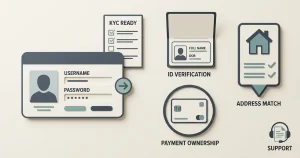
The guide explains UK law, licensing differences, player safeguards, GamStop access and how to check an offshore casino licence.
What “Non-UK-Regulated” Means in Practice
A non-UK-regulated casino is an online gambling site that operates without oversight from the UK Gambling Commission (UKGC). The label describes the regulator that does not supervise the site; it does not necessarily mean the casino has no licence at all. Many such operators hold permission from a gambling authority in another jurisdiction.
For a useful comparison, separate two details: who issued the licence and which regulator oversees the operator. A casino licensed in Malta, Curaçao, Gibraltar or Anjouan is licensed outside the UK. If it does not have UKGC oversight, it falls within the broad meaning of a non-UK-regulated casino. The overseas licence and the absence of UKGC oversight are related, but they are not interchangeable descriptions.
| Term | What it tells you |
|---|---|
| Non-UK-regulated | The UKGC does not oversee the casino |
| Malta-, Curaçao-, Gibraltar- or Anjouan-licensed | A named overseas jurisdiction is associated with its licence |
The jurisdiction name is often used as shorthand in casino descriptions. You may see a site called a Malta-licensed casino or an Anjouan casino, for instance. That wording points to the place associated with its licensing, rather than changing the basic meaning of “non-UK-regulated”: the casino operates outside UKGC oversight.
If you are considering a casino that is not UK-regulated, use this list as a starting point and check the terms and protections that matter to you. The available detail here is limited, so treat the payout information as one point to consider.
1. SlotoSport
Payout speed: 1-3 business days SlotoSport lists a payout speed of 1–3 business days, giving you a stated timeframe to consider.
2. Chanze
Payout speed: 1-3 business days Chanze lists a payout speed of 1–3 business days, giving you a stated timeframe to consider.
3. x3bet
Payout speed: 1-3 business days x3bet lists a payout speed of 1–3 business days, giving you a stated timeframe to consider.
4. Zombillion
Payout speed: 1-3 business days Zombillion lists a payout speed of 1–3 business days, giving you a stated timeframe to consider.
5. NightLuck
Payout speed: 1-3 business days NightLuck lists a payout speed of 1–3 business days, giving you a stated timeframe to consider.
6. EvoSpin
Payout speed: 1-3 business days EvoSpin lists a payout speed of 1–3 business days, giving you a stated timeframe to consider.
7. Dieselwin
Payout speed: 1-3 business days Dieselwin lists a payout speed of 1–3 business days, giving you a stated timeframe to consider.
8. SpinFormula
Payout speed: 1-3 business days SpinFormula lists a payout speed of 1–3 business days, giving you a stated timeframe to consider.
9. Revery Play
Payout speed: 1-3 business days Revery Play lists a payout speed of 1–3 business days, giving you a stated timeframe to consider.
10. NightWin
Payout speed: 1-3 business days NightWin lists a payout speed of 1–3 business days, giving you a stated timeframe to consider.
This distinction matters because “international” or “foreign” can describe a company’s location without identifying its regulatory status. The phrase “non-UK-regulated” is more precise for this comparison. It refers to oversight, not simply to where a website is hosted, where its owners are based, or which countries its games can be viewed from. Those details alone do not establish who regulates the gambling operation.
The term also covers more than one licensing jurisdiction. Malta, Curaçao, Gibraltar and Anjouan are among the jurisdictions associated with non-UK-regulated casinos, but they are not one shared regulator. A licence connected with one jurisdiction should not be treated as if it were issued by another. In practical terms, the place named in a casino’s licensing information is a separate detail from whether the UKGC oversees it.
When comparing descriptions, keep the wording literal. “Licensed overseas” identifies an overseas licensing connection; “UKGC-regulated” identifies oversight by the British regulator. A site can be described by the former without being the latter. That is the central distinction behind searches for a non-UK-regulated casino in 2026, and it prevents the word “licensed” from doing more work than it should.
So, if a casino’s description names Anjouan, Malta, Curaçao or Gibraltar, that tells you which overseas jurisdiction is being cited. It does not, by itself, make the casino UK-regulated. The jurisdiction is one column; UKGC oversight is another. Two details, not one.
What UK Law Says About Using Offshore Gambling Sites
The legal distinction is between the operator supplying gambling and the person placing a bet. The Gambling Act 2005 is directed at businesses that provide gambling services into the UK market. It is not framed as a criminal offence for an individual simply to use a gambling service licensed abroad.
That distinction matters when you are considering non-UK-regulated casinos for UK players. A site may hold permission from a foreign jurisdiction, but that does not by itself settle whether its activity is lawful in the UK. The operator’s conduct is the central issue: supplying gambling to the British market brings regulatory obligations for the business. A foreign licence and a player’s personal liability are separate questions.
The operator’s position
The Act focuses on the supply of gambling services, rather than treating every bet as a separate offence by the customer. In practical terms, the relevant legal question concerns the operator’s role in serving the market. A company cannot rely on the fact that it is based abroad as an answer to the rules that apply when it supplies gambling to people in the UK.
This is why phrases such as “accepting UK players” can obscure the important distinction. A website may be reachable from Britain or allow a person to register, but that does not establish that the operator is entitled to serve the UK market. Nor does a foreign licence turn an otherwise unlicensed service into a UK-authorised one. The licensing position concerns the business, not whether a player has committed an offence by visiting the site.
Operator Liability
A foreign licence does not establish that an operator is authorised to serve the UK market or that its activity is lawful under UK law.
The phrase “licensed offshore casino” can therefore mean only that a regulator outside the UK has issued a licence. It should not be read as a statement that the operator is authorised under UK law. The country issuing the licence and the market being served are different parts of the picture.
What the law says about the player
For an individual, the position is narrower than some warnings suggest. UK law does not expressly make it unlawful for a British citizen to use a gambling service licensed in another country. More specifically, a person who gambles on an unlicensed site does not commit a criminal offence under UK law merely by doing so.
That does not mean every arrangement is approved, protected or lawful for the operator. It means the legal responsibility described here falls on the business supplying the service, rather than on the customer for placing a bet. Keep those two points separate: the operator may face a licensing issue, while the player does not become a criminal simply because the site lacks UK authorisation.
The distinction also applies to non-GamStop casinos for UK players. A site’s relationship with a self-exclusion scheme is not the test of whether a customer has committed a criminal offence. The question of the operator’s obligations remains separate from the player’s personal liability.
“Not a crime” is not the same as “fully regulated”
When comparing offshore casinos for UK players with fully regulated UK casinos, avoid treating the player-liability point as a general endorsement. It does not certify a particular service, confirm that the operator may lawfully target Britain, or guarantee that the terms of a foreign licence align with UK requirements.
Non-Gamban Casinos in the UK: What It Means
Likewise, a foreign licence is not a blanket permission to supply gambling wherever the operator chooses. It describes the operator’s position under the issuing jurisdiction; it does not answer every question about the UK market. The legal distinction is straightforward, even if the marketing language is not.
If you are weighing up a foreign-licensed service, separate three questions in your own notes: where the operator is licensed, whether it is authorised to serve the UK market, and whether you personally face criminal liability for using it. The facts are not interchangeable. The first concerns the overseas regulator, the second concerns the operator’s obligations here, and the third concerns the customer’s position under UK law.
It should not be confused with permission for an operator to supply gambling without meeting the rules that apply to the UK market. No personal offence does not mean operator approval.
How UKGC Licensing Applies to Online Casinos
For a casino service offered to customers in Great Britain, the key question is not where the operator is headquartered. The operator must hold a licence from the UK Gambling Commission (UKGC) to serve that market. A company does not avoid this requirement by running its business from another country or holding permission from a foreign regulator.
That distinction separates a UKGC-licensed service from one that is licensed overseas but operates outside the UKGC system. A foreign licence and a UKGC licence are not interchangeable: each comes from a different authority, and an overseas authorisation does not by itself meet the requirement to serve customers in Great Britain.
Licensing Requirement
An operator serving customers in Great Britain must hold a UK Gambling Commission (UKGC) licence, regardless of where the company is based or if it holds a foreign regulator’s permission.
The operator matters more than its location
The licensing requirement attaches to the operator providing the gambling service, not simply to the casino’s address, website domain or the location of its equipment. If an operator is serving customers in Great Britain, its base of operation does not remove the need for UKGC authorisation.
This is why “licensed somewhere” and “licensed to serve Great Britain” are different descriptions. A casino may hold approval from a regulator abroad, yet still not have the UKGC licence required for this market. The overseas authorisation may be relevant in the jurisdiction that issued it; it does not replace the British requirement.
| Situation | What the licence establishes |
|---|---|
| Operator serves customers in Great Britain and holds a UKGC licence | It has the UKGC authorisation required for that service |
| Operator holds an overseas licence but no UKGC licence | Its foreign authorisation does not fulfil the UKGC requirement for serving Great Britain |
| Operator is based outside Great Britain but holds a UKGC licence | Its overseas base does not, by itself, remove the licensing requirement |
The right comparison depends on what you are assessing; a foreign licence alone is not evidence of UKGC authorisation.
What “regulated in the UK” means here
When people refer to a UK-regulated online casino, they generally mean a service operated under the relevant UKGC licence for customers in Great Britain. The important point is the licence held by the operator for the market it serves. A casino’s marketing language, country of incorporation or foreign regulatory badge cannot substitute for that.
“Online casino licensed and regulated” can therefore mean different things unless the regulator and market are specified. A casino regulated by an authority overseas may be regulated in that authority’s jurisdiction. That does not make it a UK-regulated casino. For Great Britain, UKGC licensing is the relevant standard.
This also explains why the phrase “regulated casino” needs context. It may describe oversight in another country, or it may refer to an operator authorised by the UKGC for the British market. Those are not equivalent regulatory positions. The regulator matters.
Great Britain is the relevant market in this rule
The licensing requirement discussed here concerns customers in Great Britain: England, Scotland and Wales. The term “UK” is often used casually in casino descriptions, but this particular rule is framed around Great Britain. Keeping the geography clear avoids treating a foreign licence as if it were a UKGC licence simply because the casino is accessible online.
The practical test is therefore not whether the operator has a physical office in Britain. It is whether it serves customers in Great Britain, and whether it holds the UKGC licence required for doing so. A locally based operator cannot rely on an overseas authorisation instead; nor can a foreign-based operator use its location as an exemption.
A baseline, not a quality label
UKGC licensing establishes the regulatory basis for an operator serving Great Britain. It does not, by itself, tell you which casino will suit your preferences or make one operator “best” on every measure. That depends on the criterion you care about. For the narrower question of whether a casino is regulated for the British market, however, the distinction is straightforward: an overseas licence does not replace the UKGC licence required of operators serving Great Britain.
Keep the categories separate. “Licensed overseas” describes an operator’s authorisation in another jurisdiction; “UKGC-licensed” describes the authorisation relevant to serving Great Britain. A site can present one fact prominently, but only the latter addresses the British licensing requirement. That is the regulatory baseline.
Do
- Check for a UKGC licence to confirm British market authorisation
- Treat UKGC licensing as the regulatory baseline for Great Britain
Don’t
- Assume an overseas licence replaces the need for a UKGC licence
- Treat a foreign regulatory badge as evidence of UK regulation
Player Protection: The Safeguards You May Lose
A licence is not just a label attached to a casino. It affects which rules apply when you deposit, set limits, share personal information or need help resolving a complaint. If you compare a UK-regulated casino with a non-UK-regulated casino, the practical question is not simply where the operator is based: it is which protections you can rely on if something goes wrong.
Responsible-gambling controls
UKGC-licensed operators must provide mandatory responsible-gambling tools. At a non-UK-regulated casino, those requirements may not apply, and you may not have access to the same protections. Deposit limits, for example, should not be assumed to be available or to work in the same way they do at a UK-regulated casino.
That difference matters before you play, not only after a problem arises. A tool is useful only if it is offered, easy to find and available when you need it. An offshore site may have its own account controls, but their presence does not make them equivalent to mandatory UK safeguards. Check the terms and account settings directly; do not treat a general claim about “responsible play” as proof that a particular control exists.
This is separate from the question of whether a casino is part of a particular self-exclusion scheme. The broader point is that the responsible-gambling requirements attached to UKGC oversight may not follow you to a site operating outside that system.
Personal information and data protection
Data protection is another area where the standards may differ. Non-UK-regulated casinos may operate under less stringent data-protection rules than UKGC-licensed operators. That does not establish that every such casino mishandles information; it means you should not assume the same regulatory framework applies.
Online casino no registration in the UK: checks
Before opening an account, consider what personal and financial details the operator asks for, how its privacy terms describe their use, and which organisation is responsible for the site. The key comparison is the protection framework behind the promise, not the wording of a privacy page alone. A polished policy is not, by itself, evidence of equivalent oversight.
This is especially relevant when an account involves identity checks or payment information. You may need to provide sensitive details, yet the safeguards governing their handling can depend on the operator’s jurisdiction and rules. If those arrangements are unclear, that uncertainty is part of the risk—not a minor footnote.
Complaints and independent help
Players at offshore casinos lose access to the UK’s Financial Ombudsman Service in relation to their gambling with that operator. They also cannot assume that UK complaint routes will be available simply because they are in Britain or used a familiar payment method. If a dispute develops, the route for challenging the operator may therefore be narrower or different from the one available with a UKGC-licensed casino.
This changes the value of a written complaint process. Read the casino’s terms to see how it says complaints are handled and who, if anyone, can review the outcome independently. A contact form or an internal complaints team is not the same thing as access to the UK’s Financial Ombudsman Service. If the operator’s response does not resolve the issue, having no equivalent UK route can leave you with fewer practical options.
Loss of Protections
At a non-UK-regulated casino, you may lose access to mandatory responsible-gambling tools and the UK’s Financial Ombudsman Service for dispute resolution.
Compare the protection, not the label
“Internationally licensed” describes where an operator may be authorised; it does not mean that UK safeguards automatically apply. Similarly, calling a site an unregulated casino can obscure the distinction: it may hold a licence somewhere, while still operating outside UKGC oversight. For your decision, the useful criteria are whether mandatory responsible-gambling tools apply, what data-protection framework covers the operator, and which complaint routes are actually open to you.
No single criterion makes one casino the best choice for every player. If access to UK-mandated tools and a UK complaint route is your priority, a UKGC-licensed operator offers a different protection framework from a non-UK-regulated site. If you consider an offshore service, assess those gaps explicitly rather than assuming its licence fills them. The label is not the safeguard.
GamStop and Casinos Outside the Scheme
GamStop is a UK self-exclusion scheme, but its reach is not universal. Casinos not on GamStop are outside the scheme, so registering with GamStop does not place those sites within its exclusion process. If you are looking for a way to prevent yourself from gambling, that distinction matters more than the label attached to a casino.
A non-UKGC-regulated casino may accept players without being connected to GamStop. The practical point is not simply that a site has a different licence: it is that the self-exclusion request made through GamStop does not cover a casino outside the scheme. Searching for non-GAMSTOP casinos can therefore lead you to services that do not apply the block you may be relying on.
Non-UK Registered Casinos: Licensing and Player Rights
What GamStop does—and does not do
Self-exclusion is intended to help you restrict your access to participating gambling services. It is not a general internet filter and does not itself prevent access to every gambling website. When a casino is outside GamStop, you should not assume that your scheme registration will stop you from opening an account or gambling there.
That makes the distinction important if you have excluded yourself because gambling is causing harm, or because you want a firm barrier during a period when you might otherwise return to it. A casino not regulated by the UKGC may sit outside the UK scheme, leaving you without that particular barrier on its site. The responsible decision in that situation is not to treat the absence of a block as permission to play.
You can also avoid relying on a site’s general wording as proof that it participates. The relevant question is whether the casino is actually covered by GamStop. A statement that a casino is “responsible” or offers its own account controls does not, by itself, mean that it is part of the national self-exclusion scheme.
The Anjouan limitation
Anjouan-licensed casinos are not required to integrate GAMSTOP. That means an Anjouan casino licence does not establish that the site will honour a GamStop exclusion. If self-exclusion coverage is your priority, the licence and the scheme are separate matters: one does not demonstrate membership in the other.
Anjouan-licensed casinos also do not have to provide an independent dispute-resolution route comparable to services approved under the UKGC framework. That is relevant if a disagreement arises, but it does not change the core self-exclusion point: you should not expect GamStop to cover an operator that is outside the scheme.
GamStop Reach
Since Anjouan-licensed casinos are not required to integrate GamStop, a licence from this jurisdiction does not guarantee that a site will honour your self-exclusion.
The same caution applies when considering Curaçao casinos not on GamStop. The key criterion is scheme participation, not the jurisdiction named in a site’s branding. A foreign licence does not make a casino part of GamStop, and a search result or marketing description is not a substitute for checking whether the service is covered.
If you have self-excluded, do not use a site’s lack of GamStop coverage as a workaround. Where you need help maintaining that boundary, contact a support service such as GamCare or GambleAware rather than testing whether an excluded site will let you play. The barrier is only as broad as the services it covers.
Offshore Licences: What Jurisdiction Differences Mean
A licence issued outside the UK does not tell you, by itself, what happens to your balance if a casino fails, how its games are tested, or who can consider a complaint. Those details depend on the licensing framework, so comparing casinos regulated outside the UK means looking beyond the licence label.
Anjouan provides a clear example of why that distinction matters. Its framework does not require casinos to keep player funds separate from operating money. If an operator fails, players are unsecured creditors: they do not have the protection of a guaranteed, separately held player balance. A licence, then, is not the same thing as a promise that your funds are ring-fenced.
The same framework does not mandate random-number-generator testing or audits. That does not establish that every Anjouan casino skips testing or auditing; it means the framework does not require those measures. For you, the practical difference is between a safeguard required by the regulator and a practice that an individual operator might choose to adopt.
Complaints present another important comparison point. The Anjouan authority does not handle, mediate or decide disputes between players and casinos. Anjouan-licensed operators also do not provide an independent dispute-resolution route comparable to the services approved under UK regulation. The framework requires operators to respond to complaints within 30 calendar days, but a response from the operator is not the same as an independent decision.
| What to compare | What Anjouan’s framework provides |
|---|---|
| Player funds | Segregation is not required; players are unsecured creditors if the operator fails |
| Game testing and audits | RNG testing and audits are not mandated |
| Complaints | The authority does not adjudicate; there is no comparable independent ADR route |
| Operator response | A complaint response is required within 30 calendar days |
This is why “licensed outside the UK” is too broad to serve as a safety rating. A Curaçao casino outside GamStop and an Anjouan casino should not be assumed to operate under identical rules simply because both are outside the UK system. Nor does the jurisdiction name alone establish what a particular operator does in practice. Compare the specific protections its regulator requires, especially around funds, testing, audits and dispute handling.
The strongest distinction is not whether a site displays a licence badge, but what that licence obliges the operator and regulator to do when something goes wrong. For Anjouan, the stated limits are material: funds need not be segregated, testing and audits are not mandated, and complaints do not go to an independent adjudicator. Those are concrete differences, not fine print.
Are Slot Machines Regulated by the Casino’s Licence?
A slot game does not hold a UK Gambling Commission licence in its own right. The relevant question is whether the operator offering it is authorised to provide gambling services to customers in Great Britain. That distinction matters when you see a game described as available at a “UK regulated slot casino”: the regulatory status belongs to the gambling business, not to each machine or title separately.
How slot machines are regulated
Regulation applies to the operator providing the gambling service, not to the individual slot machine or game title. A game’s design or software provider does not establish the regulatory status of the casino.
For online play, the operator must hold a UK Gambling Commission licence if it serves customers in Great Britain, wherever the company is based. A casino’s overseas address does not remove that requirement. So when you assess a site, look at who runs the gambling service and whether that operator is licensed for the British market. A game’s name, design or software provider cannot answer that question on its own.
This is also the practical answer to “how are slot machines regulated?” in an online casino context: the regulator’s requirement applies to the operator supplying the service. It is not a separate UKGC approval attached to every slot game a casino displays. The distinction avoids a common mix-up between the regulation of the service and the identity of the product.
A UKGC-licensed operator may offer many different slots, while the same game title could appear on services run by different operators. The title alone therefore does not establish whether the casino offering it is regulated for Great Britain. Check the operator, not just the game catalogue or a label beside a slot.
If a site presents slots to British customers but its operator does not hold the required UK Gambling Commission licence, the game itself does not make the service authorised. Conversely, a licensed operator’s status relates to its gambling service; it does not mean each slot has an individual UKGC licence.
The criterion is straightforward: for British customers, the operator’s licence is what counts. A slot is the product, not the licence-holder.
Non-GamStop European Casinos: How Exclusion Works
Crypto Casinos and Payment Routes
A payment method does not determine whether a casino is regulated. A site taking cryptocurrency is not automatically licensed or unlicensed because of that choice: what matters is the operator and the rules under which it accepts customers. For casinos serving Great Britain, the relevant requirement is a UK Gambling Commission licence, regardless of where the operator is based.
Non-UK-regulated casinos may offer several ways to deposit, including credit cards, e-wallets, bank transfers and cryptocurrencies. Some process transactions through alternative payment providers, so the name appearing on a payment record may differ from the casino’s name. Check the payment terms before sending funds; an available deposit route does not necessarily mean the same route can be used for a withdrawal.
Crypto has a specific connection to the UK’s credit-card gambling ban. A cryptocurrency deposit can bypass the direct use of a credit card to fund gambling, because the casino receives digital currency rather than a card payment. That does not make the casino UK-regulated, or establish that the funds used to buy the cryptocurrency came from an acceptable source. The distinction is about the route of payment, not the status of the operator.
Mobile-bill and prepaid-balance deposits are also mentioned in a specialist review, but that report should not be treated as evidence that these options are widely available or remain available at a particular casino. If offered, they work differently from a bank transfer: the charge may appear on a phone bill or reduce an existing prepaid balance. Verify the operator’s current terms and the identity of the payment provider before proceeding.
Payment Verification
- Identify which payment methods the casino accepts
- Determine who processes each transaction
- Verify if the operator is authorised to serve customers in Great Britain
For a practical comparison, separate three questions: which methods the casino accepts, who processes each transaction, and whether the operator is authorised to serve customers in Great Britain. A cryptocurrency option may suit someone who wants to avoid a direct card transaction; a bank transfer or e-wallet may be easier to trace through familiar records. Neither preference answers the licensing question. Different criteria, different answer.
What the UK Gambling Commission Can—and Cannot—Do
The UK Gambling Commission’s role matters most when a casino is licensed to serve customers in Great Britain. Its oversight gives you a UK regulatory framework to refer to if a dispute arises with that operator. A casino regulated by the UK Gambling Commission is therefore not simply a site with a licence somewhere: it falls within the Commission’s remit for the British market.
That distinction affects your options when something goes wrong. If you use a UKGC-licensed casino, you can use the complaint routes available for disputes involving a regulated operator. The Commission is not a personal claims service, however, and its presence does not mean every complaint will be resolved in your favour. It provides regulatory oversight; it does not guarantee a particular outcome.
With an offshore casino outside the UKGC system, the position changes. You cannot take a complaint to the UK Gambling Commission as though the site were one of its licensees. You also lose access to the UK’s Financial Ombudsman Service and to the responsible-gambling tools that UK rules require. Those are practical differences, not merely distinctions between licence labels.
The Commission’s reach has limits. It cannot make an offshore operator part of the UK system simply because a British customer uses its site, nor can you rely on UK complaint routes for a dispute with an operator beyond its oversight. The relevant comparison is therefore not only which casino offers the terms you prefer, but which regulator stands behind the service and which remedies remain available to you.
Casino Guides for UK Deposits, Apps and Licensing
If access to UK complaint channels and required safeguards is your priority, UKGC oversight is the stronger criterion. If you choose a non-UK-regulated casino, understand that those UK routes do not follow you there. No UK backstop.
How to Check an Offshore Casino Licence
Treat a licence claim as something to verify, not as proof that a casino may serve you. For an Anjouan casino licence, start with the public register of the stated licensing authority. Find the entry yourself rather than relying on a badge or a link supplied by the operator.
Compare three details: the licence record, its expiry date and the company name shown on the casino’s own terms or legal page. The names should match, and the licence should not have expired. If the operator’s site gives a different company name, or you cannot find a corresponding public entry, the claim remains unconfirmed. A logo alone establishes nothing.
Then check what the licence permits. An Anjouan casino licence does not authorise the operator to serve customers in the United Kingdom or other restricted markets. A genuine licence can therefore still be irrelevant to whether the casino is entitled to operate where you live.
To verify a UKGC casino licence, use the UK Gambling Commission’s public register and compare the operator’s legal name with the details on the casino site. Check that the licence is current and covers the relevant activity. Do not treat a foreign licence as a substitute for UKGC authorisation: operators serving customers in Great Britain need the appropriate Commission licence, regardless of where they are based.
Keep a record of the entry and the operator details you checked. If the names, status or dates do not align, pause rather than assuming the discrepancy is harmless. The decisive criterion is a match between the public record and the company operating the site—not the confidence of the casino’s wording.
What payment methods work best at non-UK-regulated casino sites?
You may find credit cards, e-wallets, bank transfers and cryptocurrencies accepted, sometimes through alternative processors. Some sites also allow phone-bill or prepaid-balance payments; withdrawals can take from 24 hours to five business days, or as long as three to four weeks.
Are non-UK-regulated casinos legal for UK players to use?
You do not commit a criminal offence under UK law simply by gambling on a site licensed abroad or on an unlicensed site. However, operators serving customers in Great Britain require a UK Gambling Commission licence, and an overseas licence does not provide that authorisation.
Are sites that are not on GamStop legal for players in the UK to access?
You do not commit a criminal offence simply by using a site that is not on GamStop. These sites are outside the UK Gambling Commission’s self-exclusion scheme, and operators serving Great Britain still require a UKGC licence.
Are gaming sites not on GamStop permitted for UK players?
You are not committing a criminal offence merely by gambling on a site that is not on GamStop. But the site’s absence from the scheme does not authorise its operator to serve Great Britain; operators doing so require a UK Gambling Commission licence.
What are non-UK-regulated casinos?
They are online gambling sites not overseen by the UK Gambling Commission. They may hold licences from overseas jurisdictions such as Malta, Curaçao, Gibraltar or Anjouan, but those licences are not UKGC authorisation.
Material created by the team Betmac Casino