

A practical guide to licensing status, bonus conditions, crypto payments and payout rules for operators outside the UKGC system.
What “Offshore” Means for a UK Player
In the UK market, “offshore” describes the operator’s position in relation to British regulation, not simply the location of its website. A foreign casino is an online gambling operator that accepts British customers but does not hold a licence from the UK Gambling Commission (UKGC). It may be based abroad; the defining point is that it is outside the UKGC’s licensing system.
That distinction matters because a company’s location and its permission to serve customers in Great Britain are separate questions. The Gambling Act 2005 governs gambling in England, Wales and Scotland. Under that framework, an operator offering remote gambling to customers in those nations must hold the relevant UKGC licence, wherever the company itself is based. A licence issued elsewhere is not a UKGC licence.
So “offshore casino” is not a synonym for “legal UK casino”. Online gambling is authorised in Britain through operators licensed by the UKGC. A foreign operator that takes British customers without the required UK licence is not authorised to provide those gambling facilities in Great Britain. The legal issue sits with the operator’s provision of the service, rather than being transferred automatically to the person placing a bet.
When you assess offshore casinos as a UK player, payout timing is one practical detail to check. Use the listed payout speeds as a starting point when deciding what to investigate further.
1. SlotoSport
Payout speed: 1-3 business days SlotoSport lists a payout speed of 1–3 business days, giving you a stated timeframe to consider.
2. Chanze
Payout speed: 1-3 business days Chanze lists a payout speed of 1–3 business days, a useful detail for your review.
3. x3bet
Payout speed: 1-3 business days x3bet lists payouts as taking 1–3 business days, so you have a stated timeframe to factor in.
4. Zombillion
Payout speed: 1-3 business days Zombillion lists a payout speed of 1–3 business days. You can use this as one point to assess.
5. NightLuck
Payout speed: 1-3 business days NightLuck lists a payout speed of 1–3 business days, providing a clear timing detail for your consideration.
6. EvoSpin
Payout speed: 1-3 business days EvoSpin lists payouts as taking 1–3 business days, a timeframe you may want to keep in mind.
7. Dieselwin
Payout speed: 1-3 business days Dieselwin lists a payout speed of 1–3 business days, which gives you a stated expectation for payout timing.
8. SpinFormula
Payout speed: 1-3 business days SpinFormula lists payouts as taking 1–3 business days, offering one concrete detail for your assessment.
9. Revery Play
Payout speed: 1-3 business days Revery Play lists a payout speed of 1–3 business days, a timing detail to consider as you research.
10. NightWin
Payout speed: 1-3 business days NightWin lists payouts as taking 1–3 business days, giving you a stated timeframe to factor into your review.
The operator’s position is not the player’s
For a British player, the personal legal position is different. There is no UK law that makes it a criminal offence for an individual to place a bet with an overseas operator. In other words, an operator can be outside the UKGC system while the player is not committing a crime merely by using that service.
That is a narrow point about personal liability. It does not turn an offshore site into a UK-authorised casino, nor does it mean the operator is entitled to provide gambling to customers in Great Britain without a UKGC licence. The two statements can be true at once: the operator may be acting outside the licensing rules that apply to its service, while the individual player faces no criminal penalty simply for betting there.
This is the distinction to keep in view when you read descriptions such as “available to UK players” or “accepts UK customers”. They describe who can access or use a service; they do not establish that the operator holds the permission required under British gambling law. Availability and authorisation are not interchangeable.
The word “offshore” can also blur the difference between location and regulatory status. An operator may be located outside the UK, but geography alone does not answer whether it is licensed to serve Great Britain. Conversely, the term used in a site’s branding does not change the underlying test: does the operator hold a UKGC licence for the activity it offers to British customers? If not, it sits outside UKGC regulation.
Casino Guides for UK Deposits, Apps and Licensing · Gibraltar Casino Licence and UK Gambling Rules
For a comparison of online offshore casinos, then, “best” cannot sensibly mean “most legal” for a British customer merely because a site welcomes registrations. The operator’s UK authorisation is a separate threshold from the player’s personal liability. Treating those as one question produces the wrong answer to both.
Tax is a separate question
A further distinction concerns winnings. Gambling winnings are not subject to UK income tax, whether the casino is UKGC-licensed or not. That tax treatment does not change the operator’s licensing position: a player’s winnings being untaxed does not make an offshore operator authorised in Great Britain.
It helps to keep these issues in separate columns:
| Question | What it means |
|---|---|
| Does the operator hold a UKGC licence? | Whether it is authorised under the British licensing system to provide the relevant gambling service. |
| Is the player committing a crime by betting with an overseas operator? | No; there is no criminal penalty for the player simply for placing a bet with one. |
| Are gambling winnings taxable as UK income? | No, regardless of whether the operator holds a UKGC licence. |
The table is not a ranking of sites. It is a way to avoid collapsing operator permission, player liability and tax into a single label. Each answers a different question.
For you, the practical baseline is straightforward: “offshore” means outside UKGC regulation, not automatically illegal conduct by the player and not equivalent to UK authorisation. A foreign operator’s ability to accept British customers does not settle its legal position. Nor does the fact that an individual player is not committing a criminal offence give that player the same status as someone using a UKGC-licensed casino.
That is the jurisdictional starting point. The operator’s licence, the player’s legal exposure and the tax treatment of winnings are separate matters; keep them separate when interpreting claims about an offshore casino online in the UK.
How to Assess an Offshore Site Without Treating It as UK-Regulated
A comparison of offshore casino sites for UK players needs a different starting point from a comparison of UK-licensed operators. None of the sites in this category is regulated by the UK Gambling Commission. A site may describe itself as licensed offshore, but that does not make it UK-regulated or give it the same status as a casino holding a UKGC licence.
Attention: An offshore license does not make a casino UK-regulated or provide the same protections as a UK Gambling Commission license.
That distinction sets a limit on what a rating can mean. “Best” might mean clearer licence information, more convincing security explanations or terms that are easier to understand. It cannot mean “best protected by the UK Gambling Commission”. Decide which criterion matters to you before treating a ranking as a verdict. The winner depends on what you need—and a table should make that visible.
Check what the licence claim actually says
Start with the operator’s own account of its licensing: which authority it names, which company holds the licence and whether the information is easy to find. Then look for confirmation from the named authority rather than relying only on a badge or a sentence on the casino’s website. Check that the licensed company is the same one identified in the site’s terms. A recognisable logo is not proof on its own.
Some specialist reviews describe many non-GamStop platforms as licensed and regulated by other authorities. Treat that as a claim to verify, not a guarantee about every site. The phrase “offshore licensed casino” tells you only that the operator claims a licence outside the UK system; it does not establish the scope of that licence, the company covered by it or how useful the authority would be if a dispute arose.
Keep two columns in your comparison: what the operator claims and what you can independently confirm. If the licence details are missing, inconsistent or difficult to check, record that as uncertainty rather than silently awarding the site the benefit of the doubt. A stated licence is not a UKGC licence.
Separate security claims from regulatory status
Security is another criterion, but it answers a different question. Non-GamStop casinos may use encryption to protect personal and financial information. That can be relevant to how data is transmitted or stored; it does not establish that the operator is trustworthy, that a licence claim is valid or that a complaint will be resolved fairly.
Encryption protects how data is transmitted or stored, but it does not guarantee that an operator is trustworthy or that a license claim is valid.
Read the site’s privacy and security explanations and look for a clear account of what information it collects and how it says it protects it. Compare the specificity of the explanation, not the confidence of its wording. Broad assurances such as “advanced security” are difficult to assess unless the operator explains what they mean. A padlock symbol or polished design is not a substitute for checking the company and licence details.
Avoid collapsing these checks into a single label such as “legit”. A site could make a plausible security claim while leaving its licensing unclear; another could identify an offshore regulator while offering little detail about data protection. Those are separate findings. Neither makes the site UK-regulated.
Build a comparison that shows its limits
For each offshore casino site you assess, note the operator’s stated licensing authority, the company named in its terms, whether those details can be checked independently, and how clearly its security practices are explained. Add a separate field for what remains unverified. This makes an offshore casinos list more useful than a bare ranking: the reader can see which criterion produced the apparent advantage and where the evidence stops.
Do not treat a high position in a “top offshore casino sites” list as independent confirmation. A ranking is only as useful as its method. If it does not explain how licensing claims and security information were assessed, the order may tell you less than the promotional language surrounding it.
USA Casinos for UK Players: What to Check
The practical conclusion is modest: you can compare the clarity and verifiability of a site’s claims, but you cannot turn those checks into UKGC oversight. “Legit” needs a criterion. For this comparison, use verifiable licensing information and transparent security explanations—and keep the absence of UK Gambling Commission regulation plainly in view.
Crypto Casinos: Consider the Whole Payment Journey
Choosing an offshore crypto casino is not just a decision about how to fund an account. You need to consider whether the payment method works for you at deposit and withdrawal, what information the operator may request, and whether you are comfortable with the operator’s rules. The most suitable option is the one whose full process you understand—not simply the one shown first on a deposit page.
Before you deposit
Start by checking which cryptocurrencies and payment routes the casino actually accepts. A method that appears familiar may not be available for both deposits and withdrawals, so read the payment information before transferring funds. Check that you can use the required wallet or service and understand the steps involved in sending and receiving money.
Pay attention to the details the operator gives for making a payment. The asset and network must match the instructions provided; a transfer sent using the wrong details may not reach the account as intended. If anything is unclear, pause and ask the operator before sending funds. A deposit is not a useful test of whether the instructions were clear.
Also consider your own ability to manage the method. If you are unfamiliar with crypto wallets or cannot confidently follow the operator’s payment instructions, another available method may be a better fit. Convenience is personal. A payment option is not suitable merely because it is available.
Crypto Deposit Steps
- Verify which cryptocurrencies and payment routes the casino accepts for both deposits and withdrawals
- Confirm you have a compatible wallet or service
- Double-check that the asset and network match the operator’s instructions
Identification can still be part of the process
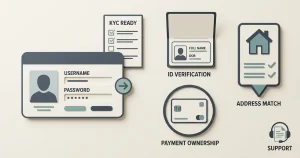
Using crypto does not remove the need to verify your details. An offshore operator may ask you to provide identification as part of its account checks, including when you are preparing to withdraw. Read the casino’s verification requirements before depositing so you know what documents or information it may request.
Give the operator accurate details and make sure the account information is consistent with the identification you provide. If a check is requested, follow the stated process and keep a record of what you submit. Do not assume that a crypto payment means an account can be used without identity checks; the payment method and the operator’s verification process are separate parts of the journey.
This matters when comparing offshore crypto casinos serving UK players. Look at the sequence: account registration, verification, deposit, and withdrawal. If the terms explain one stage but leave another unclear, that uncertainty is part of the comparison—not a minor footnote.
Check the rules before committing funds
Read the operator’s payment terms for any conditions that apply to your chosen method, including whether the same route must be used to withdraw. Confirm what information you will need to provide and how the operator describes its processing steps. Do not treat a deposit method as proof that withdrawals will follow the same route or timetable.
Best Casino App in the UK: What to Compare
Offshore operators are not regulated by the UK Gambling Commission. They also do not provide the UKGC-mandated affordability checks required of UK-licensed operators. That distinction matters when deciding whether to open an account: you should not mistake access to crypto payments for the protections attached to a UKGC-licensed casino.
The practical test is simple: can you follow the payment instructions, meet any identity checks, and accept the operator’s stated process? If not, do not deposit while hoping the details will resolve themselves later. Crypto can be one way to pay, but it does not make an unclear account journey clearer.
Bonus Terms: Calculate the Wagering Before You Deposit
A welcome offer is not worth comparing by its headline amount alone. Put the bonus value beside its wagering requirement, then calculate the qualifying stake needed before bonus funds can become withdrawable. That gives you a more useful comparison than a large figure in a banner.
A specialist review reports that offshore casinos can advertise larger welcome packages because they are not bound by UKGC restrictions on bonus terms, wagering requirements and promotional language. That describes the possible scale of an offer, not its value to you. Offshore casinos are not regulated by the UK Gambling Commission, so read the operator’s own terms and do the arithmetic before depositing.
Turn the multiple into a cash-out hurdle
Suppose a bonus is worth £20 and carries a 35x wagering requirement. You would need to place £700 in qualifying bets before cashing out. The multiple applies to the bonus amount in this example: £20 multiplied by 35. The headline £20 is therefore not £20 of immediately withdrawable money.
Bonus Hurdle Calculation
Step 1: Identify the bonus value
Determine the bonus amount, for example, £20.
Step 2: Identify the wagering multiple
Find the wagering requirement, such as 35x.
Step 3: Calculate the qualifying stake
Multiply the bonus by the requirement (£20 × 35) to find the total qualifying bets needed (£700) before cashing out.
A second example makes the effect of a bigger offer clear. A 100% match bonus of £100 with a 35x requirement calls for £3,500 in qualifying bets before the bonus funds convert to withdrawable cash. The larger bonus comes with a much larger wagering hurdle. A specialist review gives this calculation as an illustration; it is not a term that applies to every offer.
The key comparison is not simply “£20 versus £100”. It is the bonus amount, the multiplier and the resulting turnover considered together. If two offers have different requirements, calculate each hurdle before deciding which is more suitable. Bigger is not automatically better.
Read the rules behind the calculation
The multiplier is only useful if you know what the operator counts as qualifying betting. Check whether the requirement applies to the bonus, the deposit and bonus combined, or another stated amount. Do not assume the calculation from one offer carries over to another.
Read the terms for restrictions that could affect your ability to complete wagering or withdraw funds. Pay attention to which games count, any stated maximum bet while a bonus is active, and whether the offer has an expiry condition. These details can change the practical value of an offer; a low-looking multiplier does not settle the comparison by itself.
Also distinguish a deposit match from a no-deposit bonus. A no-deposit offer does not require the same initial deposit, but it still needs its own terms checked before you treat any balance as cash you can withdraw. The label alone says little about the conditions attached.
Use a small comparison table if you are weighing several offshore casino bonus offers:
| What to record | Why it matters |
|---|---|
| Bonus amount | The starting figure for your comparison |
| Wagering basis and multiple | Determines the qualifying turnover |
| Games and bet restrictions | Shows what activity counts |
| Withdrawal conditions | Clarifies when funds may be cashed out |
If an offer does not state its wagering basis clearly, its headline value is not enough to compare it. The more useful offer is the one whose conditions fit your intended play and whose cash-out hurdle you understand. Calculate first; deposit second.
Free Spins Are Still Bonus Terms
Free spins sit alongside deposit matches, no-deposit offers and cashback among the promotion types identified by a specialist review of casinos serving UK players. That describes a category of offer, not a reason to choose one. The useful comparison is what the spins let you do and what conditions apply to any winnings.
A spin is not the same as cash added to your balance. The offer may restrict which games are eligible, when the spins can be used, or how winnings must be treated before they become withdrawable. These are examples of points to check in the specific terms, not conditions that every casino applies. Read the offer attached to the account you are considering; a banner alone cannot tell you the full deal.
Compare the terms, not the headline
Put the details side by side before accepting an offer:
- Eligible games: Check whether the spins work on a particular game or across a stated selection. A large spin package is less useful if it does not cover the games you want to play.
- Use-by conditions: Look for any deadline to claim or use the spins. If the timing does not suit you, the advertised quantity has little practical value.
- Treatment of winnings: Find out whether winnings are immediately withdrawable or subject to further play or other restrictions. Do not treat a displayed balance as cash you can necessarily take out.
- Offer rules: Check whether the spins are tied to a deposit or another promotion, and whether accepting one offer affects access to another.
This checklist is more useful than ranking packages by spin count alone. The better offer depends on your priority: game choice, ease of understanding, or fewer conditions attached to winnings. If the terms are unclear, the headline does not resolve the uncertainty.
The same scrutiny applies when a promotion is described as “free”. That word can refer to the spins themselves, while the resulting winnings remain subject to the offer’s rules. Read the full terms before opting in, and keep a copy of what you accepted so you can compare it with the account’s subsequent treatment.
For a UK player, another distinction matters: offshore casinos are not regulated by the UK Gambling Commission. A site may describe itself as regulated under an offshore licence, but that does not make it a UK-regulated casino or give its promotion UKGC oversight. Assess the offer on its written conditions, and do not mistake promotional wording for a guarantee about what you can withdraw.
Do
- Check eligible games and use-by deadlines
- Verify how winnings are treated
- Read full terms before opting in
Don’t
- Rank packages by spin count alone
- Assume a “free” label means no conditions
- Mistake promotional wording for UKGC oversight
A simple decision rule helps: reject a package whose eligible games, timing or winnings conditions you cannot establish from its terms. More spins do not automatically mean better value. Terms first.
What Changes When You Play Outside UKGC Oversight
The main difference is not a feature on the casino’s homepage; it is which safeguards apply to your account. Offshore casinos are not regulated by the UK Gambling Commission (UKGC). That means you should not assume that protections attached to a UK-licensed account also follow you to a site operating outside the Commission’s remit.
GamStop is a clear example. It covers UKGC-licensed operators, so registering for self-exclusion blocks you from every UK-licensed gambling site. Offshore operators are not part of the scheme. A specialist review reports that a person who has self-excluded can register with a foreign casino and deposit within minutes, without the safeguards that GamStop provides across the UK-licensed market. The speed is precisely the problem: a barrier intended to interrupt gambling can be bypassed by moving outside the scheme.
If you have chosen self-exclusion because gambling is causing harm, treat that gap as a reason not to open an offshore account. Do not rely on the operator to recognise or honour your GamStop status; the scheme does not cover it. The same caution applies if you are comparing the best offshore casinos for UK players: a ranking or attractive feature cannot tell you that a UK-wide self-exclusion control will work there.
Self-Exclusion Risk
Offshore operators are not part of GamStop; if you have self-excluded due to gambling harm, you cannot rely on these sites to honour your status.
Affordability checks are another important distinction. UKGC-licensed operators are subject to Commission requirements, but offshore operators are not subject to UKGC-mandated affordability checks. You therefore should not expect the same regulatory process to identify or respond to signs that gambling may be unaffordable. This is not a claim that every offshore site handles spending in the same way; it is a limit on what UKGC rules require of operators outside its oversight.
That shifts more responsibility onto you, but it does not create an equivalent safety net. Before depositing, consider whether you can stop without an external block, and whether you are using gambling to recover losses or manage financial pressure. If either is true, avoiding the account is safer than relying on controls whose reach ends at the UKGC boundary.
A non-GamStop casino may advertise its own account tools, but those are not GamStop and should not be treated as a continuation of your existing self-exclusion. The practical test is simple: if a control matters to your safety, confirm that it applies to the operator you are considering. If it does not, assume that it will not protect you there. No equivalent backstop.
Why a Site Accepting UK Visitors Is Not the Same as Being Authorised
A casino website may load in Britain, display UK-facing content or allow a visitor to start registration. None of those actions establishes that the operator has permission to provide gambling facilities here. Access is a technical question; authorisation is a regulatory one.
Pay by Phone Credit at UK Mobile Casinos
For England, Scotland and Wales, a remote gambling operator serving customers must hold a UK Gambling Commission licence. An operator without that licence is not authorised to offer gambling facilities to customers in those countries. The rule concerns the operator’s conduct, not whether its site happens to be reachable from a British connection.
That distinction matters when you encounter offshore casinos accepting UK visitors. A working registration page may show that the operator has not effectively restricted access. It does not turn the site into a UK-authorised casino. Nor does a British visitor’s ability to open an account amount to approval from the regulator. A website can be accessible and still lack permission to serve this market. Those are separate tests.
The position can be less straightforward where a casino holds a licence elsewhere. A non-UK licence does not replace the UKGC licence required to serve customers in Great Britain. Gambling.com has reported that some casinos licensed outside the UK are expected to block British visitors, while some do not enforce that restriction; it also describes access being bypassed with a basic VPN. That is a report about access practices, not proof that any particular site is authorised to operate here. A block that is absent or ineffective changes what a visitor can reach, not the operator’s regulatory status.
This is why “accepting” needs care as a description. It might mean that a page opens, that registration is available, or that the operator actively permits a customer to use its gambling services. Those are not interchangeable claims. A site can leave its pages visible while its terms say that British customers are excluded; conversely, a completed signup does not demonstrate that the operator has the required UK permission.
Technical accessibility (a website loading in Britain) is separate from regulatory authorisation; a reachable site may still lack permission to serve the UK market.
The legal boundary is not limited to a site’s wording or technical settings. Providing gambling facilities to UK customers without a UKGC licence is illegal, as is advertising an unlicensed service in the UK. So the useful criterion is not whether an offshore gambling casino appears on a list of sites accepting British visitors. It is whether the operator holds the licence required to serve Great Britain. Reachability answers only the first question. Permission is another matter.
Bitcoin Withdrawals: Speed Versus Volatility
For an offshore Bitcoin casino used by a UK player, a quick withdrawal is only one part of the result. A specialist review reports that crypto withdrawals at foreign casinos can clear in under an hour, faster than fiat methods. That is a reported possibility, not a promise for every operator or transaction.
The other side of the comparison is Bitcoin’s changing value. The amount sent may be recorded in Bitcoin, while what that amount is worth in pounds can shift between the casino approving a withdrawal and you using or converting the funds. A short processing time may reduce the time spent waiting, but it cannot make the value stable. Speed is not the same as certainty.
| Criterion | What it means for you |
|---|---|
| Withdrawal time | Crypto may clear quickly, according to a specialist review; the operator’s process still matters. |
| Value | Bitcoin can change in value, so the eventual pound value may differ from your expectation. |
| Practical priority | Speed matters most if you are comfortable holding an asset whose value moves. |
If you are comparing offshore Bitcoin casinos in the UK, decide which criterion matters more before treating a fast payout as an advantage. If you need a predictable pound amount, volatility may outweigh the time saved. If you are willing to accept value changes, the reported speed may carry more weight. There is no universal winner; it depends on whether you value prompt access or steadier purchasing power.
A “legit” label does not settle that trade-off. Offshore casinos are not regulated by the UK Gambling Commission, and offshore operators do not provide UKGC-mandated affordability checks. A Bitcoin option or a promotional offer, including an offshore casino bonus, does not remove those distinctions. The relevant comparison is not simply whether a site accepts Bitcoin, but whether its withdrawal terms and the asset’s volatility fit your priorities.
Before depositing, read the operator’s rules for Bitcoin withdrawals and check whether the displayed balance and withdrawal are expressed in Bitcoin or pounds. Do not assume the amount shown at one point will have the same pound value later. The speed claim is attractive; the value risk remains.
Payout Timing Depends on Method and Operator Rules
For an offshore casino withdrawal, the payment method gives you a starting point, not a guaranteed arrival time. A specialist review reports that Skrill and Neteller withdrawals at many foreign casinos are cleared within 24 hours, with some processed in under 12 hours. That is the operator’s processing stage; your e-wallet provider may still need time to complete the transfer.
E-wallets (Skrill/Neteller)
Withdrawals are often cleared within 24 hours, with some processed in under 12 hours.
Bank Transfers
Typically the slower option, with timelines ranging from five to seven business days.
Operator Processing
Internal reviews and verification procedures can add delays regardless of the payment method used.
Bank transfers are the slower comparison. A specialist review puts the banking timeline at five to seven business days, and notes that some casinos add an internal processing period before sending the money. Weekends and bank handling can make the gap between requesting a withdrawal and seeing it in your account feel longer. If predictability matters more than using your usual bank, compare the stated e-wallet processing time with the bank’s full expected timeline.
The operator’s rules can matter as much as the method. Specialist reviews point out that withdrawal limits, pending periods and verification procedures differ considerably between casinos. A request may therefore be held for review before it is approved, or paid in stages where limits apply. Read the cashier information and withdrawal terms before depositing, and check whether a pending request can be cancelled: a displayed processing estimate does not explain every step.
Have the account details and any requested identification ready. Verification can affect when a withdrawal is approved, but the procedure is operator-specific. Do not assume that a casino’s advertised speed overrides its own checks or limits. The quickest method on paper may not be the quickest for your account.
A useful comparison is therefore not simply “which method is fastest?” It is: how long does the operator take to approve the request, what extra delay may follow, and what conditions could pause it? Offshore casinos are not regulated by the UK Gambling Commission, and they do not provide UKGC-mandated affordability checks. That protection gap sits alongside the timing question; faster processing does not replace safeguards. Read the terms first.
Offshore Licences and Conflicts of Interest
An offshore licence and a UK Gambling Commission licence are not interchangeable credentials. A casino may hold permission from an authority outside Britain, but that does not place it under UKGC regulation or authorise it to serve the British market. “Licensed offshore” describes where an operator is licensed; it does not mean that the operator is regulated for UK players.
Best Foreign Casinos for UK Players: Rules and Risks
The distinction matters when a company presents a licence as evidence of oversight. The useful question is not simply whether a licence exists, but what that licence allows. Santeda’s Curaçao licence, for instance, does not permit the company to operate in the UK or the US. Its existence therefore cannot be read as UK authorisation.
There is a second issue beyond the wording of a licence: business relationships that may affect incentives. Under a contract with Santeda, SIS received a percentage of revenues generated by losing bets placed through Santeda’s brands. That arrangement is a specific financial connection worth noticing when considering how the businesses relate to one another. It does not, by itself, establish that any particular game or outcome was manipulated; it does show that SIS had a financial interest linked to losses at those brands.
That distinction is important. A commercial relationship can raise questions about independence and incentives without proving misconduct. Readers should separate what the contract establishes—the revenue share on losing bets—from conclusions it does not establish about individual customers, games or decisions.
When you encounter a claim that a casino is “regulated offshore”, read it narrowly. Identify the named licensing jurisdiction, then keep its scope separate from UKGC oversight. In Santeda’s case, the Curaçao licence does not extend permission to operate in the UK, while the SIS contract reveals a separate commercial connection. Neither point turns the licence into a UKGC licence.
A licence answers one question: which regulator, if any, has authorised the operator in its jurisdiction? A revenue arrangement answers another: who may benefit financially from the operator’s activity? Treating those as the same question would obscure the detail that matters. The label is not the whole picture.
Can I play at a casino licensed outside the UK?
Yes, playing at an overseas casino is not a criminal offence for a British player. But a foreign licence does not authorise the operator to offer gambling to customers in Great Britain without a UK Gambling Commission licence.
Is it legal for UK residents to use casino sites that operate outside the UK’s licensing framework?
Yes, an individual does not commit a crime simply by betting with an overseas operator. However, an operator without a UK Gambling Commission licence is not authorised to provide gambling facilities to customers in Great Britain.
Is playing at an international casino legal for UK residents?
Yes, a British player is not committing a criminal offence simply by placing bets with an overseas casino. That does not mean the casino is authorised to serve customers in Great Britain.
What should I do if a casino refuses to pay my winnings?
If the casino is unlicensed, you may have no legal recourse to recover your winnings. Check the operator’s licensing status before depositing, rather than assuming a foreign licence provides UK protections.
How do I know if an online casino is safe?
Check which company and authority the casino names for its licence, then verify the claim with that authority. Review the site’s security information and terms, and remember that an offshore licence does not provide UK Gambling Commission regulation.
What happens if I have a dispute with a foreign casino?
If an unlicensed site refuses to pay, customers have in some cases been left with no legal recourse. A foreign licence does not give the casino UK Gambling Commission oversight.
Are gambling winnings subject to income tax in the United Kingdom?
No. Gambling winnings are not subject to UK income tax, whether the casino is UKGC-licensed or not.
Are foreign casinos safe for UK players to use?
Not necessarily: foreign casinos are outside UK Gambling Commission regulation, and some unlicensed sites have refused to pay winnings. Check the operator’s licence with the named authority and assess its security information and terms before using it.
Material created by the team Betmac Casino