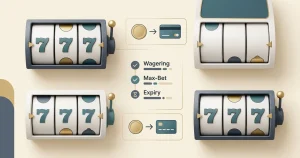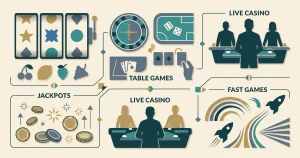
Dice-themed slots, table games and random-number games differ in how play is delivered, while licensing and payment terms vary by site.
How Online Dice Games Fit into Casino Game Categories
An online dice game can look like a single, familiar kind of casino entertainment, but the category depends on how play is delivered. A game may use dice as its theme or central visual without being a dealer-run table game. To understand what you are looking at, separate the game’s format from its subject: the format describes how the casino presents play, while the subject describes what appears on screen or in the game’s name.
Casino games are offered through online casinos where this is permitted by law. Within that setting, three broad formats help make sense of the choices: machine-style games, table games and random-number games. They describe different ways of running a game, not a ranking of which is more enjoyable or more suitable. The same word, “dice”, does not tell you which format applies.
| Format | How play is presented | What the category tells you |
|---|---|---|
| Gambling machine | A player uses a machine or digital equivalent without casino-employee involvement | Play is generally individual |
| Table game | A croupier or dealer conducts the game | The player competes against the casino, not other players |
| Random-number game | Computer or other gaming equipment generates selected random numbers | Outcomes come from a generated-number process |
When choosing a UK casino dice game, payout timing is one practical detail to consider. Use the stated withdrawal speed as a reference when deciding what suits you.
1. SlotoSport
Payout speed: 1-3 business days You can factor in a stated payout speed of 1–3 business days when considering SlotoSport.
2. Chanze
Payout speed: 1-3 business days You can factor in a stated payout speed of 1–3 business days when considering Chanze.
3. x3bet
Payout speed: 1-3 business days You can factor in a stated payout speed of 1–3 business days when considering x3bet.
4. Zombillion
Payout speed: 1-3 business days You can factor in a stated payout speed of 1–3 business days when considering Zombillion.
5. NightLuck
Payout speed: 1-3 business days You can factor in a stated payout speed of 1–3 business days when considering NightLuck.
6. EvoSpin
Payout speed: 1-3 business days You can factor in a stated payout speed of 1–3 business days when considering EvoSpin.
7. Dieselwin
Payout speed: 1-3 business days You can factor in a stated payout speed of 1–3 business days when considering Dieselwin.
8. SpinFormula
Payout speed: 1-3 business days You can factor in a stated payout speed of 1–3 business days when considering SpinFormula.
9. Revery Play
Payout speed: 1-3 business days You can factor in a stated payout speed of 1–3 business days when considering Revery Play.
10. NightWin
Payout speed: 1-3 business days You can factor in a stated payout speed of 1–3 business days when considering NightWin.
Machine-style play
Gambling machines are generally used by one player at a time and do not need a casino employee to operate the game. Online, this broad category covers play presented through a digital interface rather than a live dealer. A dice image, rolling animation or dice-related title could be part of that interface, but those visual cues alone do not make the game a table game.
The useful distinction is who or what runs the activity. If the game proceeds through a screen and does not involve a croupier conducting a round, it is not dealer-run simply because it borrows the look of a casino table. The label “dice” may describe its theme, but the delivery format is a separate question.
This matters when comparing online dice games because two titles that appear related may belong to different formats. One may be presented as a self-contained machine-style game; another may be framed as a table experience. Their names or graphics are not enough to establish the difference. Look at how the game is presented and whether a dealer is involved.
Mines Casino Game in the UK: Rules and Risks · Online Bingo UK: Formats, Slots and How to Choose
Dealer-run table games
Table games have a different structure. Players compete against the casino rather than against one another, and a croupier or dealer usually conducts the game. That human role is the defining feature of the presentation; the table setting is not merely decoration.
An online casino may present a table game through a dealer-led format, but the fact that a game involves dice does not establish that it is dealer-run. Nor does a picture of a table prove that players are participating in a live table game. The category is about the way the game is conducted, not just the objects shown on screen.
That distinction keeps the comparison practical. If you want a dealer-led experience, the relevant question is whether the game is actually conducted by a croupier or dealer. If you are simply looking for dice-themed play, the table format may not be relevant at all. Similar imagery; different structure.
Computer-generated random-number games
Random-number games use selected numbers generated by a computer or other gaming equipment. In an online setting, the visible result may be represented by graphics, but the important category feature is the use of generated numbers. A digital dice animation, for instance, does not by itself explain how the game is operated; the format needs to be understood from the game’s description and presentation.
Random-number generation and machine-style play are related ways of thinking about a game, but they are not identical labels. “Machine-style” describes a mode of play in which a player typically uses a machine without casino-employee involvement. “Random-number” describes how selected numbers are produced. A game can be presented on a screen and use computer-generated numbers, so the terms answer different questions.
Do
- Identify if the game is dealer-led or runs without an employee
- Consider whether the game uses computer-generated numbers
Don’t
- Assume the “dice” label tells you the delivery format
- Use visual cues alone to determine if a game is a table game
For someone comparing an online dice casino, that distinction avoids a common muddle. Ask first whether the game is dealer-led or runs without a casino employee. Then consider whether the game uses computer-generated numbers. These categories explain delivery and operation; they do not, on their own, tell you the detailed rules or predict what a particular result will be.
A format-first way to compare
When a game is described as online casino dice, identify the format before drawing conclusions from its name. Is it presented as machine-style play, a dealer-conducted table game, or a random-number game? Those categories give you a clearer starting point than the dice theme alone.
This approach also makes comparisons between online dice casino sites more precise. Two sites may offer games with similar visual themes, yet the games can be presented in different ways. Conversely, a game may use dice imagery without being a traditional table experience. The category is not a promise about the rules; it is a guide to the kind of delivery you are seeing.
Keep the labels in their proper place: machine-style play concerns player interaction and employee involvement; table games concern a dealer-run structure and play against the casino; random-number games concern computer- or equipment-generated numbers. Once those distinctions are clear, “dice” becomes a useful description of the subject rather than a shortcut for assuming how every game works.
Crash Casino Games UK: Stakes, Rules and Risks
Dice Casino Sites: UK-Licensed and Offshore Are Different Markets
A site advertising casino games with dice can sit in one of two very different regulatory positions. The key distinction is not the game’s name or appearance; it is whether the operator holds the licence required to offer real-money gambling to customers in Britain. “UK-facing” and “UK-licensed” are not interchangeable descriptions.
A specialist review describes the online casino market in 2026 as having two parallel sides: operators within the UK Gambling Commission’s regulatory system and offshore platforms outside it. That is a useful way to understand the landscape, provided the labels are read carefully. An offshore casino may accept players from the UK, but that does not put it inside the UKGC system or make it a licensed UK casino.
What a UKGC licence means
For real-money gambling offered to customers in England, Scotland and Wales, the operator must hold a licence from the UK Gambling Commission, or UKGC. The wider rule is that remote gambling operators selling into the British market must have the relevant Gambling Commission licence, wherever the operator is based. A company’s physical location does not remove that obligation.
This requirement has applied since the Gambling (Licensing and Advertising) Act 2014. In practical terms, a casino cannot become compliant simply by being based abroad, using an overseas website address or describing itself as international. If it takes bets from British residents, it needs the licence that allows it to serve that market.
That gives you a clearer test than a site’s branding. A casino may use British currency, mention UK players or display games that appear to suit British tastes; none of those details establishes that it is UKGC-licensed. The regulatory status is the point.
Licensing Requirement
Remote gambling operators selling into the British market must hold a licence from the UK Gambling Commission (UKGC), regardless of where the operator is based.
What “offshore” does—and does not—tell you
Offshore casinos that accept UK players operate outside the UKGC regulatory system. They may be accessible to people in Britain, but accessibility is not the same as authorisation to provide gambling services here. Nor does the word “offshore” itself tell you that an operator has UKGC oversight. It tells you the opposite: the platform is outside that system.
This distinction matters when you see a site described as a dice casino for UK players. The phrase can mean only that people in the UK can reach the platform or that the operator accepts their custom. It does not establish that the site is legally licensed to serve British customers. For a trusted dice casino, the meaningful question is therefore not simply whether the games load, but whether the operator has the relevant UKGC licence.
The wording can be confusing because both types of site may present themselves as casinos and may offer overlapping kinds of games. A player looking for dice games, slots with dice themes or other casino titles might encounter both in the same broad search landscape. But the game catalogue does not determine the legal status. An identical game category cannot turn an offshore operator into a UKGC licensee.
A practical way to read site claims
Treat claims about location, availability and licensing as separate statements:
| Site claim | What it tells you |
|---|---|
| “Accepts UK players” | The operator allows people from the UK to access its service; this alone does not show UKGC licensing. |
| “Offshore casino” | The operator is outside the UKGC regulatory system. |
| “UKGC-licensed” | The operator claims to hold a licence from the UK Gambling Commission; this is the relevant status for serving customers in Britain. |
A site’s use of terms such as “UK casino”, “UK dice games” or “casino slots with dice” should not be treated as proof of a licence. Those phrases describe an audience or a product theme, not a regulatory authorisation. The same caution applies where a platform presents itself as an alternative to UK-licensed casinos: that positioning does not change the licensing requirement for taking bets from British residents.
If a platform accepts British customers while operating outside the UKGC space, its accessibility should not be mistaken for UKGC oversight. The legal distinction remains even when the site is easy to visit. That is the part worth keeping in view.
What Makes a Dice Casino a Better Fit for You?
“Best” only means something when you name the criterion. For one player, the deciding factor may be whether the casino offers the kind of dice game they want; for another, it may be clear rules or a promotion whose conditions are easy to assess. A best dice casino for you is the one that matches your priorities, not necessarily the one with the loudest welcome offer.
Separating the game from the offer is essential; a promotion cannot make a game more suitable if you do not understand the rules and possible outcomes of the play.
Start by separating the game from the offer. Check what the game involves and how its rules explain the possible outcomes before weighing a bonus. A promotion cannot make a game more suitable if you do not understand what you are staking on. Nor does a large-looking offer tell you what you must do before any bonus funds can be withdrawn.
Compare the criteria that affect your choice
A simple comparison table can keep the decision grounded:
| Criterion | What to check |
|---|---|
| Game fit | Is the dice game you want actually available, and are its rules clear to you? |
| Offer conditions | What wagering requirements apply, and which games count towards them? |
| Relevant products | Does the incentive apply to casino play, or is it tied to other gambling products too? |
| Overall value | Does the offer suit the way you intend to play, or would you rather skip it? |
The right answer depends on which row matters most to you. If you want a particular format, availability and understandable rules may outweigh a promotion. If you are comparing offers, read the full terms rather than judging by the headline amount. A bigger bonus can come with more work attached.
Read wagering requirements in pounds and stakes
A wagering requirement states how much must be staked before bonus funds can be withdrawn. Translate the multiple into a total, rather than leaving it as abstract offer language: £100 in bonus funds with a 35x requirement means £3,500 in bets. A £20 bonus at 10x means £200 in total stakes. Those totals are not a promise of a return; casino games can give the house a predictable advantage over the long term, even though players may win in the short term.
A specialist review of the 2026 incentive rules reports that, from 19 January 2026, wagering requirements on bonus funds cannot exceed 10x. That makes the £100-at-35x illustration useful for understanding the arithmetic, not as a compliant offer to expect under that rule. Check the terms shown for the specific promotion, including which stakes count and when the requirement is considered complete.
The same specialist review says one incentive cannot combine different gambling product types, such as casino and betting. That distinction matters if an offer appears to reward activity across more than one part of a site: identify what the promotion covers before opting in. Fine print is still part of the price.
Online Casino Tournaments UK: Free Entry Explained
Decide whether the bonus helps
A bonus is not automatically an advantage for you. If you would not otherwise meet its conditions, declining it may be the clearer choice. If you do want it, compare its wagering requirement with the amount of bonus funds and confirm that the eligible games include the play you intend to choose.
The winner depends on your criterion. No universal champion.
Dice Roll Slots: What the Slot Format Means
A dice-themed slot is still a slot, even if its artwork, symbols or title centre on dice. The distinction matters: a slot’s format is not the same as a casino dice table game. Seeing dice on the screen does not tell you that you are choosing a dice outcome or following the rules of a particular dice game.
The label “dice roll slot” can therefore point to a theme rather than a single, standard game. One title might use dice as visual symbols; another might build its presentation around a roll. The wording alone does not establish how a game works, whether it includes a particular feature, or whether it is available at a given casino. Check the game’s own information before treating a name as a description of its rules.
Attention A "dice roll slot" name refers to a theme rather than a standard game; check the individual game information before assuming the rules or features.
What makes it a slot
The useful test is the way the game is presented and played, not the presence of dice imagery. A slot is an online slot when it uses the slot format; a dice-themed design does not turn it into a table game. Conversely, a game involving a dice wager is not automatically a slot just because it is played online.
This keeps several searches in perspective. Someone looking for a rolling-dice slot may want a slot with dice visuals, while someone searching for dice play may mean a different kind of casino game. The terms can overlap in ordinary descriptions, but they do not make the formats interchangeable. Read the rules and game information, not just the title.
Nor does “free play” in a game’s name prove that a free version is offered. A dice-themed slot may or may not have a practice option, depending on the casino and the game. Availability should be checked where the game is presented; the theme itself promises nothing. A demo label is not a rulebook.
UK slot rules to keep in view
For online slots in Britain, the maximum stake per game cycle is £5 for customers aged 25 and over. The same cap applies to all adults since 9 April 2025. A lower maximum of £2 applies to players aged 18 to 24. These limits concern slot play, not every casino game that happens to show dice.
Aviator Casino Game UK: Licensing and Play Guide
Online slot autoplay is prohibited in Britain, and each spin must take at least 2.5 seconds. Those rules apply to the slot format regardless of whether its symbols are dice, cards or something else. If a game is presented as a slot, its dice theme does not exempt it from the slot requirements.
That is the practical distinction: theme describes the look; format determines which rules apply. Check the game’s displayed rules and controls, and do not infer its mechanics from a search-style label or a picture of dice. If your priority is a slot with dice imagery, compare the actual game descriptions. If you want a dice game, confirm that the game is a dice wager rather than a slot using dice as decoration. Similar wording; different format.
Casino Dice: The Random Outcomes and the House Edge
A casino dice game is a wager on an uncertain result: you stake cash or chips on an outcome, or on a combination of outcomes, and the game determines whether that stake wins or loses. The basic idea is simple. The important detail is that the result is random, so a run of wins or losses does not by itself tell you what the game will do next.
That distinction matters when you assess casino dice in the UK in 2026. A result can be favourable to you without showing that the game is favourable overall. Short-term gains are possible, but they sit alongside a long-term advantage for the casino. These are not contradictory statements: one describes what can happen to an individual player over a limited spell, the other describes the general direction built into casino gambling over time.
Long-term Advantage
Short-term wins are possible, but the house edge represents the casino’s mathematical advantage over repeated play.
What the house edge means
The house edge is the casino’s mathematical advantage across repeated play. It does not mean the casino wins every wager, or that a particular session must end in a loss. It means that the game’s structure tends to favour the casino over the long run. Individual outcomes still vary, and a player may leave ahead after a short session.
For you, the practical point is to separate possibility from expectation. A winning result is possible; it is not evidence that future results are due to follow the same pattern. Likewise, a losing run does not make a win “owed”. Random outcomes do not keep a running score on your behalf. The casino edge remains the relevant long-term measure, not the sequence you have just experienced.
A useful comparison between casino dice games starts with the specific wager and the terms attached to its possible outcomes. The label “dice” alone cannot tell you how favourable a game is: different games and bets can work differently. Without the rules and the relevant mathematical information for a particular wager, there is no sound basis for assigning it a precise edge or placing it above another.
Short sessions, long odds
If you are considering a dice game casino experience, decide in advance what amount you are prepared to lose and treat any winnings as uncertain, rather than as a reliable return. That is a budgeting decision, not a way to change the odds. Increasing a stake after a loss does not turn a random result into a predictable one.
Live Dream Catcher Casino in the UK: What to Check
The same caution applies when a few wins create confidence. A favourable spell may be real, but it does not cancel the casino’s long-term advantage or establish that the next result is more likely to favour you. The edge is about the game over repeated play, not a promise about the next roll.
For UK dice casinos, then, the central question is not whether a player can win; players can. It is whether you understand that possibility alongside the casino’s long-term advantage, and can accept the uncertainty without treating a short run as a forecast. Short-term luck happens. The edge stays.
Dice Casino Demos and the Limits of What You Can Verify
A demo can be useful for seeing how a dice game is presented, but its presence should not be assumed from a casino’s game listings or promotional wording. A page may use “demo” or “free play” to describe a non-cash mode; the label alone does not tell you what is available, how it works or whether it matches real-money play.
If a playable preview is offered, treat it as a way to inspect the interface, not as proof of how the game’s random outcomes are generated. Random-number games use selected numbers produced by a computer or other gaming equipment. Watching a run of demo results cannot establish that the underlying process is fair, independently tested or identical in every mode. It shows what happened in that session. Nothing more.
Limits of Demo Versions
A demo is for inspecting the interface and controls. It cannot prove that the underlying random-number generation process is fair, independently tested, or identical to real-money play.
That distinction matters when a page groups dice games, craps-style tables and dice-themed slots together. The shared imagery does not make them the same format. A dice casino demo may refer to a particular game, while a dice slot demo points to a machine-style title. “Craps” in a game description is not enough to establish the rules or betting options either. Read the individual game information rather than treating a broad label as a specification.
A preview can still help with practical questions. You may be able to see whether the controls are clear, how a stake is entered, or where the game explains its possible outcomes. These are interface observations, not evidence about the game’s long-term behaviour. If the information is not displayed, a demo cannot fill that gap by implication.
Likewise, free spins are an offer feature, not a guarantee that a dice game has a free mode. A promotion mentioning spins may relate to a slot rather than a dice game, and its terms determine what the offer covers. Separate the game format from the promotion attached to it.
The same caution applies when a page combines dice with cryptocurrency terms, such as Bitcoin Cash, Litecoin or Dogecoin. Those words describe a payment context, not what a demo contains or what rules a game follows. Check the game description and any available terms separately.
A useful test is simple: decide what you want to learn before opening a preview. Use it to assess presentation and controls; do not treat a short sequence of results as a certification. A demo can show the surface. It cannot show everything underneath.
Chicken Road Casino UK: What the Game Label Means
Crypto Dice Casinos and Craps-Related Searches
The word “crypto” describes how a platform may handle payments; it does not identify a particular dice game. A site advertising casino dice alongside cryptocurrency options could still offer different formats, so check the game’s own description rather than assuming that every dice-themed title works like craps.
Some non-traditional gaming platforms may operate under licences from Curaçao, Malta or Gibraltar. Those licences are not UKGC licences. For gambling to be legal in the UK, the operator serving UK players must hold the relevant UKGC licence; a foreign licence does not replace it. The payment method does not change that distinction.
Payment options also vary by platform. A specialist review reports that some alternative platforms may accept Bitcoin, Ethereum or Litecoin alongside conventional cards and e-wallets. Treat that as a description of particular platforms, not a promise that every site supports those methods. Check which currencies and payment routes are available, whether the account currency matches your intended deposit, and what conditions apply to withdrawals. A method appearing on a payment page is not, by itself, evidence that the operator is licensed to serve you in Britain.
Craps is a separate part of the terminology. Searches for casino craps or dice-based craps point towards a named game format, while “crypto dice” may simply refer to dice play on a platform that supports cryptocurrency. The phrases can overlap in a site description, but one does not establish the other: a crypto casino need not offer craps, and a craps listing does not tell you which payment methods are supported. Read the rules shown for the individual game before staking.
UKGC Licence
Required for legal gambling services provided to customers in England, Scotland, and Wales.
Offshore Licence
Licences from Curaçao, Malta, or Gibraltar that operate outside the UKGC regulatory system.
Crypto Payments
Payment options including Bitcoin, Ethereum, or Litecoin, which do not change licensing requirements.
A specialist review also reports that some platforms process deposits instantly and complete withdrawals within hours rather than days. That is a report about certain operators, not a reliable timetable for every payment. Network processing, platform checks and the chosen method can affect what happens, so look for the operator’s stated conditions before transferring funds.
Keep the comparison tidy: assess the game label and payment arrangement as separate criteria. If a platform makes both easy to verify, that is more useful than a broad “crypto dice” label.
Bitcoin Dice Casinos: Payment Options and Player Protections
Bitcoin is a payment method, not a guarantee that a casino offers a particular dice game or that its terms suit you. A specialist review reports that some alternative platforms may accept Bitcoin alongside Ethereum, Litecoin, conventional cards and e-wallets. That is a description of possible payment options, not a promise that every site supports each method. Check the cashier and the operator’s terms before deciding whether a deposit route works for you.
The same distinction matters when a site is aimed at UK players. Using Bitcoin does not change the rules for offering gambling to people in Great Britain: remote operators selling into the British market must hold a UKGC licence. Offshore casinos operate outside that regulatory system, so their payment options should not be mistaken for evidence that they are licensed to serve the UK.
JetX Casino Game in the UK: How It Works
Compare the whole payment route
Before depositing, check which currency the account accepts, whether the cashier requires conversion, and what the operator says about deposits and withdrawals. Confirm any applicable fees, processing conditions and identity checks in the site’s own terms; do not assume that a Bitcoin payment is instant or that a withdrawal follows the same route as a deposit. A payment option can look simple at the deposit stage and still be unsuitable if the cash-out conditions are unclear.
Also separate a dice game from a promotion attached to it. A dice casino bonus is an offer, not a feature of Bitcoin or of the game. Read the conditions that apply to the offer before accepting it, and do not treat a headline amount as money you can withdraw freely.
Protection tools need checking too
A specialist review reports that alternative platforms generally provide their own player-protection features, such as deposit limits, session timers and self-exclusion. Look for those controls in the account area and establish how they work before you play. Their presence may help you manage activity, but it does not make an offshore site UKGC-regulated or replace the protections required of a UKGC licensee.
For a practical comparison, score each site separately for payment choice, clarity of withdrawal terms and access to account controls. Bitcoin support is only one row in that table. Clear terms matter more.
How to Play Casino Dice Without Assuming Every Game Is the Same
The common thread is the wager: you stake cash or chips on a possible outcome, or on a combination of outcomes. The dice are part of how an outcome is produced, but that does not make every game interchangeable. Before placing a bet, identify what the game asks you to predict and what event would count as a win.
Before Placing a Stake
- Identify what outcome you are backing
- Determine what makes the selection win or lose
- Confirm the exact payout that applies to the bet
Read the wager before you stake
Start with the rules displayed for that specific game. They should explain the available bets, how outcomes are determined and what each winning selection pays. Do not infer a rule from the word “dice” or assume that a familiar-sounding game follows the same procedure elsewhere.
That distinction matters when comparing casino dice payouts. A payout applies to a particular bet under that game’s rules; it is not a general rate for dice wagers. Check whether the displayed return includes your original stake, and make sure you understand what happens to the stake when the selection loses. If those points are unclear, pause rather than treating an attractive-looking figure as self-explanatory.
Know what produces the result
In an online random-number game, selected numbers are generated by a computer or other gaming equipment. The presentation may show dice, but the essential point for your wager is the outcome recognised by the game and the rules attached to it. A visual roll alone does not tell you which bets are available or how they are settled.
At a physical table, the procedure can differ from an online game. The game’s instructions—not the general idea of rolling dice—determine how a player participates. “Craps” is a specific game name, not a safe shortcut for the rules of every casino dice game. If you want to learn how to play craps at a casino, use the rules for that particular table rather than transferring assumptions from another format.
A simple check before play
You should be able to answer three questions from the game information:
- What outcome am I backing?
- What makes that selection win or lose?
- What payout applies to this exact bet?
If any answer is missing or ambiguous, do not place the stake until the rules are clear. The useful starting point is not memorising a universal dice system; it is understanding the wager in front of you. Same dice, different rules.
Comparing Dice Casino Sites by Payments and Offer Terms
A useful comparison starts with two separate checks: how money moves, and what a promotion asks you to do before its value can be withdrawn. Keep them in different columns. A smooth deposit process does not make restrictive offer terms better, and a generous-looking bonus does not make payment conditions irrelevant.
For payments, note which methods are available and how clearly the casino explains deposits and withdrawals. Open Banking and Faster Payments have made transfers to and from online casinos less cumbersome, but the practical details still depend on the method and the operator. Check whether the same route works in both directions, and whether any stated processing conditions apply. Credit cards cannot be used to fund gambling at UK-licensed casinos.
Crazy Time Live Casino Game Show UK: What to Check
For offers, compare the wagering requirements, validity period and any limits on winnings. A specialist casino review reports that some alternative-platform bonuses have lower wagering requirements and longer validity periods than other offers; treat that as a claim to verify against the promotion’s own terms, not as a rule for every site. Free spins need their own line in your comparison: a specialist review also notes that some casinos cap the winnings, so the advertised spins may not determine the amount you can keep.
Read the full conditions before opting in. Check which games count towards wagering, whether a minimum deposit applies, when the offer expires and whether winnings are capped. If the promotion combines different gambling products, that is not an eligible offer at a UK-licensed casino. Since 19 January 2026, UK rules also cap wagering requirements on gambling incentives at 10 times the bonus funds.
The better fit depends on your priority: fewer payment steps, or terms you can assess before accepting an offer. Put both on the same checklist. A headline bonus is not a comparison.
Material created by the team Betmac Casino