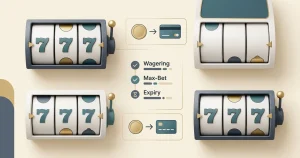
Reel structure, wager rules, features and volatility each shape a slot session in different ways.
How Reel Layout Changes the Bet
A slot’s reel layout is the arrangement of the vertical columns that spin and the symbols shown in each column. It describes the game’s visible structure, but it does not, by itself, tell you how much of your wager is assigned to each part of the game. To understand the cost of a spin, look at the bet rules alongside the layout.
A five-reel slot gives you a straightforward example. The reels are the columns across the screen; they are not separate games or separate wagers by default. A game can apply one bet across all five reels. That means the amount displayed as the stake can cover the full reel set rather than requiring you to treat each reel as an independent purchase.
This distinction matters when you compare games. The same-looking layout does not guarantee the same way of applying a bet. One title may show a single total stake for a spin, while another may present choices about how the wager is distributed within its rules. The layout tells you what is on screen; the paytable or game information tells you what your selected stake covers. Read both before deciding that two games with similar reels have equivalent betting structures.
High-volatility slots can mean more variable results, so you may want to consider practical details alongside game choice. Use the payout information below as one factor when reviewing your options.
1. SlotoSport
Payout speed: 1-3 business days SlotoSport lists a payout speed of 1–3 business days, a useful detail for you to consider when choosing where to play.
2. Chanze
Payout speed: 1-3 business days Chanze lists a payout speed of 1–3 business days. This gives you a stated timeframe to factor into your choice.
3. x3bet
Payout speed: 1-3 business days x3bet lists a payout speed of 1–3 business days, giving you a practical cashout detail to keep in mind.
4. Zombillion
Payout speed: 1-3 business days Zombillion lists a payout speed of 1–3 business days. You can use this stated timeframe as one part of your review.
5. NightLuck
Payout speed: 1-3 business days NightLuck lists a payout speed of 1–3 business days, which may help you consider cashout timing.
6. EvoSpin
Payout speed: 1-3 business days EvoSpin lists a payout speed of 1–3 business days. This is a practical detail for you to weigh alongside your slot preferences.
7. Dieselwin
Payout speed: 1-3 business days Dieselwin lists a payout speed of 1–3 business days, giving you a stated timeframe to consider for payouts.
8. SpinFormula
Payout speed: 1-3 business days SpinFormula lists a payout speed of 1–3 business days. You can take this cashout information into account when reviewing the option.
9. Revery Play
Payout speed: 1-3 business days Revery Play lists a payout speed of 1–3 business days, a useful practical point for you to consider.
10. NightWin
Payout speed: 1-3 business days NightWin lists a payout speed of 1–3 business days. This gives you a stated payout timeframe to factor into your decision.
Separate the picture from the stake
A row of reels can make a game look as if each column has its own price. That is not a safe assumption. In a five-reel slot, the wager may be applied across all five reels as one overall bet. The crucial detail is the game’s stated stake for a complete spin, not the number of columns visible.
If the interface offers bet controls, check what each control changes. It might alter the total stake or another part of the game’s betting setup. Do not infer the effect from the button’s position or from the reel arrangement. Confirm the displayed total before starting a spin, then check that the game description explains how combinations are evaluated.
This is a practical distinction rather than a promise about results. A stake covering every reel does not mean every spin will produce a winning combination, nor does it say how often wins occur. It only describes how the wager is applied in that game. The reel layout and the betting rules answer different questions.
What the layout can—and cannot—tell you
The reels show the framework in which symbols land. They help you follow the play and understand where a combination might appear, provided you also consult the game’s paytable. The paytable supplies the rules for symbol combinations and any relevant conditions. Without it, the screen is a picture, not a complete explanation of the bet.
Best Video Slots in the UK: How to Choose
This is especially useful when a game is described as high volatility. That label does not change the meaning of a reel or tell you whether the stake is split across columns. A high-volatility slot machine can still have a five-reel layout, and its wager can still be applied across all five reels. Reel count describes structure; the volatility label describes a different aspect of the game. Treating one as evidence of the other is a category error.
The same caution applies when browsing slot machines with high volatility or comparing what might be called the best high-volatility slot machines. A visually broad layout is not a measure of betting value, and a compact screen does not reveal the full stake rules. Before comparing titles, identify the total cost of a spin and what that cost covers. Only then can you make a like-for-like comparison of the structure.
A quick reading order
When a game opens, work through its information in this order:
- Identify the reel layout shown on screen.
- Find the stated total stake for a spin.
- Check whether that stake is applied across the full reel set.
- Read the paytable for the rules governing combinations.
This avoids confusing the visible arrangement with the wager. If the game has five reels, do not assume that you must assign a separate stake to each one; the game may apply the bet across all five. If the interface is unclear, use the game’s rules rather than guessing from the display.
A useful comparison table can keep the details straight:
| Detail | What it tells you |
|---|---|
| Reel layout | How the spinning columns are arranged |
| Total stake | The amount wagered for a spin |
| Bet rules | How that stake is applied |
| Paytable | Which combinations and conditions the game recognises |
The table’s purpose is modest: keep unlike details in separate columns. Reel layout can affect how you read the screen, while the bet rules establish what your wager covers. Neither should be used as a shortcut for judging the other.
So, when someone asks what a high-volatility slot machine means, the reel layout is not the answer. It tells you how the game is arranged. To understand the wager, check the stake rules; to understand the game’s other characteristics, read their own descriptions. Different questions. Different boxes.
Playing High-Volatility Slots Online in Great Britain
If you are looking for high-volatility slots online in Great Britain, the first practical distinction is between the game and the market in which it is offered. The game’s label does not change the rules that apply to a real-money slot. Those rules concern the operator, how a stake is placed and the protections available to you.
Attention: Reported stake ceilings for customers can change; always verify the current applicable limits in the operator’s terms.
A specialist review reports a per-cycle stake ceiling of £5 for customers aged 25 and over, and £2 for those aged 18 to 24. Treat that as a reported description of the limits, rather than relying on an old page as your final word: requirements can change, and the operator’s current terms should make the applicable limit clear. A high-volatility label does not create an exception to a stake limit.
The relevant regulator for remote gambling offered to consumers in Great Britain is the UK Gambling Commission. Its remit does not depend on where an operator keeps the equipment that runs a game. A business cannot avoid the rules for the British market simply by hosting its systems elsewhere. The Commission is the sole regulator for commercial gambling in Great Britain, and it also regulates gambling activity in the wider United Kingdom, including online casinos.
Licensing responsibilities are split between businesses and people. The Commission grants operating licences to businesses and personal licences to individuals carrying out regulated roles. For you, the practical point is that a real-money casino serving British customers should be operating under the appropriate UKGC licence. Online gambling is legal in the UK at licensed and regulated sites; an offshore location by itself is not a substitute for a British licence.
Before depositing, use the Commission’s public register to check that the operator’s licence is current and that the business name matches the casino you intend to use. A familiar-looking brand or a polished game lobby is not proof of licensing. If the register and the site’s details do not line up, pause rather than treating the discrepancy as a minor technicality. That check is more useful than judging an operator by how prominently it advertises its slot catalogue.
Licensing
A real-money casino serving British customers should be operating under the appropriate UK Gambling Commission licence.
Age controls are another part of the practical picture. Operators must verify a customer’s age before allowing a deposit into a gambling account, and online gambling is legal for adults aged 18 and over when the operator holds a UK Gambling Commission licence. This sits alongside the different stake ceilings reported for the two adult age bands; being old enough to open an account does not mean the same per-cycle limit applies to every customer.
A legal operator’s obligations continue after registration. UK-licensed casinos must provide responsible-gambling tools, including self-exclusion, and remote operators must prompt new customers to set a financial limit before their first deposit while making account-level limit controls accessible. Credit cards cannot be used to fund gambling with UK-licensed casinos. These are not features that tell you whether a slot is volatile; they are part of the conditions surrounding real-money play.
When comparing high-volatility online slots in the UK, keep the questions in the right order: confirm the operator’s status, understand the stake limit that applies to you, then look at the game information. The regulator sets the framework for the market; it does not endorse individual slots or guarantee how a game will perform. The paperwork is not the entertainment.
What High Volatility Means for Your Session
With a high-volatility slot, the session can feel uneven. Payouts arrive less often, but when a win does land, the amount can be larger. That pattern shapes the rhythm of play: long stretches may pass without a payout, followed by a result that changes the balance more noticeably.
3-Reel Slots in the UK: How to Choose
The important word is “can”. A high-volatility game does not promise a large win after a quiet run, or guarantee that a session will include one at all. Each spin may add another losing result without bringing the next payout closer. Waiting longer does not create a debt the game must repay.
That can make the balance appear to move in steps rather than through a steady sequence of small returns. You may see it fall during a run without a win, then rise sharply if a larger payout occurs. The reverse is also possible: the balance can keep falling, with no substantial return to interrupt the decline. A dramatic result is possible, not scheduled.
For that reason, it helps to think about the whole session rather than judge the game by one spin. A small payout may not offset the wagers made since the previous win, while a bigger one may make the session look quite different in an instant. Neither outcome tells you what the next spin will do. The game does not read the room.
The same unevenness can affect how long a session feels. When wins are scarce, play may seem to move slowly even if spins continue at the same pace. A player can become more focused on the next result, especially after a dry stretch. That feeling is part of the experience, not evidence that a payout is due. Continuing simply because a win seems overdue is a poor way to decide whether to keep playing.
Risk of Loss
Continuing to play simply because a win seems overdue is a poor way to decide whether to keep playing.
It is also easy to remember the largest result more clearly than the quiet stretches around it. A memorable payout can make the session feel more successful in retrospect, even if it did not recover what had been spent. Keeping track of the balance, rather than relying on the excitement of an individual win, gives you a more accurate picture of what happened.
If you are looking at high-volatility slots, read the payout pattern as a description of possible session rhythm, not as a promise about your own results. The key feature is the combination of less frequent payouts and potentially larger amounts when they occur. It says nothing certain about whether your next session will be short, profitable or memorable.
That distinction matters because the experience can be intense without being rewarding overall. A large payout may stand out; a long run without one may dominate the session. You can encounter either pattern, or finish without seeing the result you hoped for. High volatility describes the shape of possible returns, not a timetable for them.
Game Features That Shape Volatility
A slot’s feature list can offer clues about its design, but no single feature proves that it is high or low volatility. Compare the mechanics together, and treat labels as a starting point rather than a complete description. That matters when you are weighing high-volatility slot games: a striking bonus mechanic may look dramatic without telling you how often it pays or how large its returns tend to be.
Bonus buy slots in the UK: demo play and stakes
Low-volatility games provide a useful contrast. They commonly use a five-reel layout with at least twenty-five paylines, set jackpot prizes rather than pools that grow progressively, and bonus rounds that multiply wins already accumulated. These traits describe a familiar design pattern, not a rule that every game must follow. A larger number of paylines, for instance, does not by itself establish how volatile the game is.
Paylines indicate which symbol arrangements can count as winning combinations. Their number tells you something about the ways a game recognises a win, but not the size or frequency of returns across play. Read the paytable alongside the paylines: the same line structure can sit alongside different prize values and bonus rules. The reel layout and bet controls also matter to the wager, so check what the game says about how your stake is applied rather than inferring it from the feature count.
Jackpots need similar care. A fixed jackpot has a stated prize amount; a progressive pool can change as contributions accumulate. That distinction describes how the prize is set, not how often it is won. A fixed jackpot can appear in a game with other mechanics that shape its overall volatility, while the presence of a progressive prize alone does not establish the whole game’s payout pattern. One feature is not a verdict.
Bonus rounds are another point where descriptions can sound more informative than they are. A multiplier-based round increases wins that have already accumulated, but the word “multiplier” does not tell you how likely the round is to occur, what triggers it, or what its typical contribution is to the game’s returns. Check the rules for those details. A bonus can be visually prominent and still be only one part of the design.
Low-volatility design patterns
Low-volatility games commonly use a five-reel layout with at least twenty-five paylines, set jackpot prizes rather than pools that grow progressively, and bonus rounds that multiply wins already accumulated.
When comparing slot games with high volatility, look beyond the feature names to the rules that govern them: winning combinations, prize values, jackpot terms and bonus triggers. The same applies if you are looking for very high volatility slot games or comparing high volatility casino games in the UK. A list of features may help you understand how a game works; it cannot, on its own, rank games by volatility.
That is why a high number of paylines should not be treated as a shortcut to finding the best high-volatility slot games. Nor does a multiplier round settle the question. Use the published game information to identify what each mechanic does, then keep the volatility label separate from the mechanics themselves. Clearer comparison, fewer assumptions.
Is High Volatility the Better Fit for You?
Neither style is inherently better. The useful comparison is whether you value the possibility of a larger payout more than the prospect of smaller returns appearing more regularly. High volatility may suit you if that potential is part of the appeal and you can accept that payouts are less frequent. Low volatility may be more comfortable if you prefer returns to be spread across more frequent, smaller wins.
That distinction matters when choosing what kind of experience you want, but it does not tell you which game will pay during a particular session. A high-volatility slot can go through a long stretch without a payout, and a low-volatility slot can still leave you with a loss. The pattern describes how returns are distributed, not a promise about your next spin.
Best Keno Online Casinos in the UK: Key Comparisons
Which trade-off suits you?
If you would find a run of losing spins frustrating, the possibility of a larger win may not compensate for the wait. A lower-volatility game can feel more reassuring because small wins tend to arrive more often. Yet those returns may be modest, and seeing wins on screen is not the same as ending with more money than you started with.
High volatility can appeal when the chance of a larger payout matters more to you than frequent smaller wins. That appeal comes with a real trade-off: you may play for longer without a return. The right fit therefore depends less on which label sounds exciting and more on how you respond to uneven results.
A practical way to decide is to consider what would make a session feel acceptable to you. If you would rather see regular, modest returns, low volatility may fit that preference. If you can tolerate fewer payouts in exchange for the possibility of larger ones, high volatility may be closer to what you want. Neither choice makes a result predictable.
The limit both styles share
Volatility changes the distribution of outcomes; it does not erase the game’s underlying house edge. Over enough play, a game with an edge in the casino’s favour has a negative expected result for the player. That remains true whether losses arrive gradually through small returns or are interrupted by less frequent, larger payouts.
Volatility Choice
Choose by the payout pattern you are willing to experience, not by the assumption that one style changes the long-run advantage.
This is why “better” needs a criterion. Low volatility may be better for someone who values frequent smaller wins; high volatility may be better for someone drawn to the possibility of larger payouts and prepared for longer gaps. Neither is better as a way to overcome the game’s mathematics. There is no winning label.
So, is high volatility good or bad in slots? It can be a good fit for a particular preference, but a poor one for someone who dislikes long periods without a payout. The same applies in reverse to low volatility: its more regular small wins may feel preferable, but they do not ensure a profitable session. Choose by the pattern you are willing to experience, not by the assumption that one style changes the long-run advantage.
RTP and Volatility Measure Different Things
RTP and volatility answer different questions. RTP describes a game’s theoretical return over extensive play; volatility describes how that return is distributed. A high RTP figure therefore does not tell you whether wins will arrive frequently, whether they will be small, or whether a rare payout might be much larger.
That distinction matters when comparing high RTP, high-volatility slots. The RTP figure may look attractive on paper, but it cannot tell you what your own session will produce. A game can have a comparatively high stated return and still pay less often, with more of its returns concentrated in larger wins. Another game’s returns may arrive in smaller amounts more regularly. The figures describe different properties, not competing measures of the same one.
What RTP can—and cannot—tell you
Treat RTP as a long-run theoretical measure, not a forecast for your next spins. It does not promise that a particular player will receive a set share of their stakes, nor does it specify when returns will occur. A short session can differ sharply from the theoretical pattern. Even over longer play, the figure does not set a timetable for wins.
Online Slots Payout Percentages: What They Mean
Volatility fills in part of that picture by describing the distribution pattern. Low-volatility slots tend to spread returns across many smaller wins. High-volatility slots pay out less often, but the wins can be larger. Neither description changes the game’s RTP; it helps explain the shape that returns may take.
So a search for the best high-RTP, high-volatility slots combines two separate criteria. The RTP figure concerns theoretical return, while volatility concerns the pattern of payouts. You would need to consider both, and neither alone establishes that a game will suit your expectations or produce a particular result.
The house edge still matters
A high RTP should not be read as an absence of a house edge. Where a game has a positive house edge, its mathematical expectation remains negative over enough sessions. That is true whether losses build gradually through frequent small payouts or appear alongside longer stretches without a win.
RTP vs Volatility
One describes theoretical return; the other describes the distribution of outcomes. They can be considered together, but they cannot cancel each other out.
This is why RTP is not a shortcut to identifying a game that pays often, and volatility is not a measure of how favourable its long-run expectation is. One describes theoretical return; the other describes the distribution of outcomes. They can be considered together, but they cannot cancel each other out.
For very high-volatility slots, the same distinction applies: a strong RTP figure cannot establish that wins will be frequent or large in your session. Read the two measures separately, then judge them against what you want to understand about the game. No figure turns a theoretical measure into a promise.
What Makes a Slot High Volatility?
A high-volatility slot is one whose returns are concentrated in less frequent, larger payouts rather than spread across many smaller wins. Volatility describes the distribution of outcomes: it is about how wins tend to be arranged in a game’s results, not a promise about what any particular spin will pay.
That distinction matters when you are identifying what the label means. A slot does not become high volatility simply because it has a striking theme, elaborate graphics or a dramatic bonus screen. The term refers to its payout pattern. High-volatility slots pay out less often but in larger amounts when wins occur; low-volatility slots tend to distribute returns across more frequent, smaller wins.
The label is a description of the game’s design, not a forecast for your next play. A high-volatility game can produce a win sooner than you expect, or a stretch without one. Neither result contradicts the label: individual outcomes do not have to follow a tidy sequence. Volatility describes the pattern across the game’s results, not a schedule that tells you when a payout is due.
So, when asking what high-volatility slots are, focus on the balance between payout frequency and payout size. The defining feature is not simply that a possible win is large; it is that larger payouts are less frequent within the overall distribution. A game with occasional big prizes is not necessarily classed as high volatility on that detail alone. The broader pattern is what matters.
This also separates volatility from a description of how one session will unfold. A session is a short run of play, and its sequence of results can look different from the game’s general payout pattern. The classification does not tell you how long to play, when a win will arrive or what the outcome of a session will be. It gives you a way to describe the distribution, not a timetable.
When comparing descriptions of games, treat “high volatility” as a broad category rather than a precise prediction. The term helps distinguish a design centred on less frequent, larger payouts from one that spreads returns across smaller wins. It does not, by itself, specify the size of a potential prize or the length of a losing run.
In short, volatility is a property of the payout pattern; a session is one sample of play. Keep those ideas separate and the label becomes easier to read without mistaking it for a promise.
The label is not a forecast.
Attention: High volatility describes the shape of possible returns, not a timetable for them; the label is not a forecast.
Bonuses, Session Planning and the Limits of Strategy
A bonus can change how much play an offer permits, but it cannot change the underlying expectation of a slot. Before accepting, read the terms that govern eligible games, required play and withdrawal conditions. Treat those conditions as part of the decision, not as small print to inspect after you have started.
A specialist review describes bonuses as commonly lasting 48 hours. That is a short window, so check the expiry time and any play-through conditions on the offer itself before opting in. If you cannot use the bonus within its stated period, the headline value may be less relevant than the restrictions attached to it. Offers are not a reason to extend a session you had already planned to end.
With high-volatility games, a bonus does not make results more predictable. It may provide additional play under its terms, but it does not ensure a return or turn a losing run into a winning one. If you are weighing a high-volatility casino bonus strategy, use a practical test: would you still choose the game and stake if the offer were absent? If not, the promotion may be driving the decision rather than improving it.
Plan the session around a fixed amount you are willing to lose and a stopping point that does not depend on a win arriving. Do not raise stakes to recover losses, or keep playing because a bonus is close to completion. Those choices can increase exposure; they do not give you control over the next result. A bonus has terms. It is not a system.
The mathematics remains unchanged across long play: when a game’s rules give the casino a positive edge, the expected result for the player is negative over enough sessions. That remains true whether losses arrive gradually or in uneven bursts. No bonus condition or session routine reverses that expectation.
So is high volatility good when a bonus is involved? It depends on whether its payout pattern suits your tolerance for uncertainty and whether you understand the offer’s conditions. Judge the promotion by its rules and your own limit, not by the possibility of a large win. Stop when your planned session ends, even if the bonus remains unfinished.
How to Read Slot Features Without a Shortlist
A list of titles can look decisive while telling you very little about how each game works. Before treating any collection of slots with high volatility as a useful shortlist, read the game information for specific mechanics: reel setup, bet coverage, available features and the figures the provider actually publishes. A title is not a specification.
Start with the betting description. A 5 reel slot game may let you apply a bet across all five reels, but do not assume that every displayed bet setting covers them in the same way. Check whether the game explains what the selected stake includes and how its reels or win lines are treated. This is a practical detail: if the wording is unclear, you cannot make a sound comparison of the cost of a spin.
Before Choosing a Slot
- Identify the reel layout shown on screen
- Find the stated total stake for a spin
- Check if the stake is applied across the full reel set
- Read the paytable for rules governing combinations
Then separate named features from their effects. A bonus round, wild symbol or multiplier tells you what may happen during play; the feature label alone does not tell you how often it will appear or what it will return. Look for the rules attached to it, including any conditions for triggering or completing the feature. If those rules are not stated clearly, record the uncertainty rather than filling it with an assumption.
RTP and volatility labels can help organise a comparison, but neither replaces the game rules. If you are looking for slots with high RTP and volatility, check that both figures are explicitly given for the particular game. Do not infer one from the other, or treat a headline figure as a promise about an individual session. The published information is a description, not a forecast.
A compact comparison table keeps the criteria visible:
| What to check | What it tells you |
|---|---|
| Bet coverage | Which reels or lines the selected stake applies to |
| Feature rules | What must happen for a bonus or symbol effect to operate |
| Published RTP | The stated return figure, where provided |
| Volatility label | The game’s stated volatility category, where provided |
Use the same checks for any best high volatility slots list you come across. If the entries do not give comparable information, the list cannot establish which game suits your priorities. It can only point you towards titles to inspect further. A neat ranking is not a mechanic.
Low vs High Volatility: The Session Trade-Off
The difference between low- and high-volatility slots is easiest to notice in the rhythm of a session. Low-volatility games spread returns across many smaller wins, so a run of play may include more frequent winning combinations. High-volatility games tend to pay out less often, with larger amounts when a win does arrive. The contrast is about the pattern of outcomes, not a promise about what any particular run will bring.
Across most low-volatility titles, winning combinations typically appear every three to six spins on average. That describes a broad pattern, not a schedule: individual games and sessions can vary, and a combination does not necessarily mean that the spin has returned the full stake. Frequent small wins can make the balance move in shorter steps, but they do not mean that every sequence will feel steady.
High-volatility play has a more uneven cadence. You may see longer stretches without a payout, followed by a larger win. That larger amount can change the balance more noticeably, but its arrival is not timed by the spins that came before it. A quiet patch does not make a payout due.
| Session feature | Low volatility | High volatility |
|---|---|---|
| Typical payout rhythm | More frequent, smaller wins | Less frequent, larger payouts |
| How the balance may move | Smaller changes, more often | Longer pauses and sharper changes |
| What a win tells you about the next spin | Nothing certain | Nothing certain |
The table describes tendencies, not outcomes you can count on. Low volatility does not mean that every spin pays, and high volatility does not mean that a larger payout will follow a losing stretch. Results remain variable in either style.
This matters when you judge a session by its feel. Frequent small wins can create a busier sequence without guaranteeing that the balance is rising overall. In a high-volatility game, a long quiet interval may be followed by a substantial payout, or the session may end without one. Neither rhythm supplies a reliable forecast.
The practical comparison is therefore one of pace: more small returns distributed through play, or fewer, potentially larger returns separated by quieter spells. The session can depart from either pattern. A neat rhythm is not promised.
Material created by the team Betmac Casino